THE CONTEXT: WHY THIS MOMENT MATTERS
By mid-2026, the AI race had reached a new level of intensity. Just as the industry seemed to be settling into a familiar rhythm—with OpenAI rolling out steady improvements, Anthropic refining Claude’s careful, safety-focused approach, and Google working to close the gap—Z.ai (formerly Zhipu AI) unexpectedly shifted the conversation with the release of GLM-5.2.
Emerging from the research ecosystem of Tsinghua University, Z.ai has spent years building powerful language models with far less global attention than many of its Western rivals. GLM-5.2 is more than another technical milestone. It reflects a different vision for developing, deploying, and governing advanced AI systems. That shift is significant enough to make leading AI companies rethink ideas they had begun to take for granted.
Rather than treating this as another chapter in the rivalry between AI companies, it’s worth looking beyond the headlines. The more important story lies in the different philosophies driving these models, the choices their creators are making, and the long-term consequences those choices could have as AI becomes a larger part of everyday life.
Inside GLM-5.2: What Makes Z.ai’s New Model Different
GLM-5.2 is Z.ai’s latest flagship language model. It takes a noticeably different path from many Western architectures while delivering strong performance.
The model uses a Mixture-of-Experts (MoE) backbone with optimizations such as IndexShare, which enables efficient handling of a 1-million-token context window. This makes it particularly effective for long-horizon tasks, including working with large codebases, multi-step agentic workflows, and extended reasoning.
Its training emphasized multilingual capabilities, with strong performance on Chinese, Japanese, Korean, and Southeast Asian languages, giving it notable cultural and linguistic fluency in those contexts. The model is designed from the ground up for agentic use — planning multi-step workflows, interacting with tools, and executing complex coding tasks with minimal prompting.
On independent coding and agentic benchmarks (such as Terminal-Bench, FrontierSWE, and SWE-bench variants), GLM-5.2 ranks as one of the strongest openly available models, often trading blows with GPT-5.5 and staying close to Claude Opus 4.8 while offering significantly better cost efficiency. It was released initially to GLM Coding Plan users on June 13, 2026, with open weights under a permissive MIT license made available shortly after.
One early reviewer described the experience simply:
“GLM-5.2 doesn’t try to be your friend. It behaves more like a highly capable coworker, and that difference becomes obvious once you start working with it.”
Claude Mythos: A Different Philosophy
Anthropic has consistently taken a different approach to building advanced AI systems. While much of the industry has focused on expanding capability as quickly as possible, the company has invested heavily in alignment, interpretability, and reducing harmful or unreliable behavior. The Claude Mythos series (Preview launched April 2026, with Mythos 5 in June 2026) continues that direction, with particular strength in cybersecurity, biology, and healthcare domains through initiatives like Project Glasswing.
Anthropic treats safety as a core design principle rather than a post-training layer. Key elements include Constitutional AI, advanced interpretability research, and calibrated uncertainty. The model is designed to acknowledge its limits more reliably and handle sensitive requests with nuance. Access to the most capable Mythos variants remains restricted due to their dual-use potential, particularly in cybersecurity.
These choices produce a noticeably different experience. Claude Mythos may not always lead raw capability benchmarks, but it often behaves more cautiously and reliably in high-stakes domains such as healthcare, finance, legal services, and scientific research.
WHAT’S IN THE NEWS: A TIMELINE
April 7, 2026 — Anthropic releases Claude Mythos Preview, highlighting breakthrough capabilities in cybersecurity and launching Project Glasswing.
June 9, 2026 — Anthropic launches Claude Mythos 5 and the safeguarded Claude Fable 5 variant.
June 13, 2026 — Z.ai releases GLM-5.2 to Coding Plan users, followed by open-weights release under MIT license.
Mid-June 2026 — Discussions intensify around geopolitical implications, open vs. closed models, and access restrictions on certain advanced Western models for non-US users.
THE ACCUSATIONS: WHAT ANTHROPIC ACTUALLY SAID
Anthropic has raised broader, ongoing concerns about the development and governance of frontier AI models from different ecosystems — particularly around transparency, independent safety evaluations, data practices, and accountability mechanisms. These are not new criticisms but reflect deeper philosophical and geopolitical differences.
Z.ai has responded by emphasizing its open research contributions, cost accessibility, and invitation for third-party audits. Both sides raise valid points about safety, governance, and commercial interests. The debate highlights the lack of universally accepted international standards for frontier AI.
WHY BOTH MODELS ARE GENUINELY GOOD
GLM-5.2 STRENGTHS:
Raw capability per dollar — Strong coding and agentic performance at a fraction of the cost of leading closed models. Highly democratizing.
Cultural and linguistic depth — Excellent handling of Asian languages and contexts.
Agentic workflow design — Native strength in long-horizon planning, tool use, and coding.
Open weights — MIT license enables broad research and self-hosting.
CLAUDE MYTHOS STRENGTHS:
Trust & safety calibration — Especially strong in high-stakes domains and cybersecurity.
Graceful degradation under pressure — Reliable behavior when uncertain.
Long-form reasoning quality — Excellent for research synthesis and nuanced analysis.
Institutional transparency — Anthropic publishes detailed system cards and evaluations.
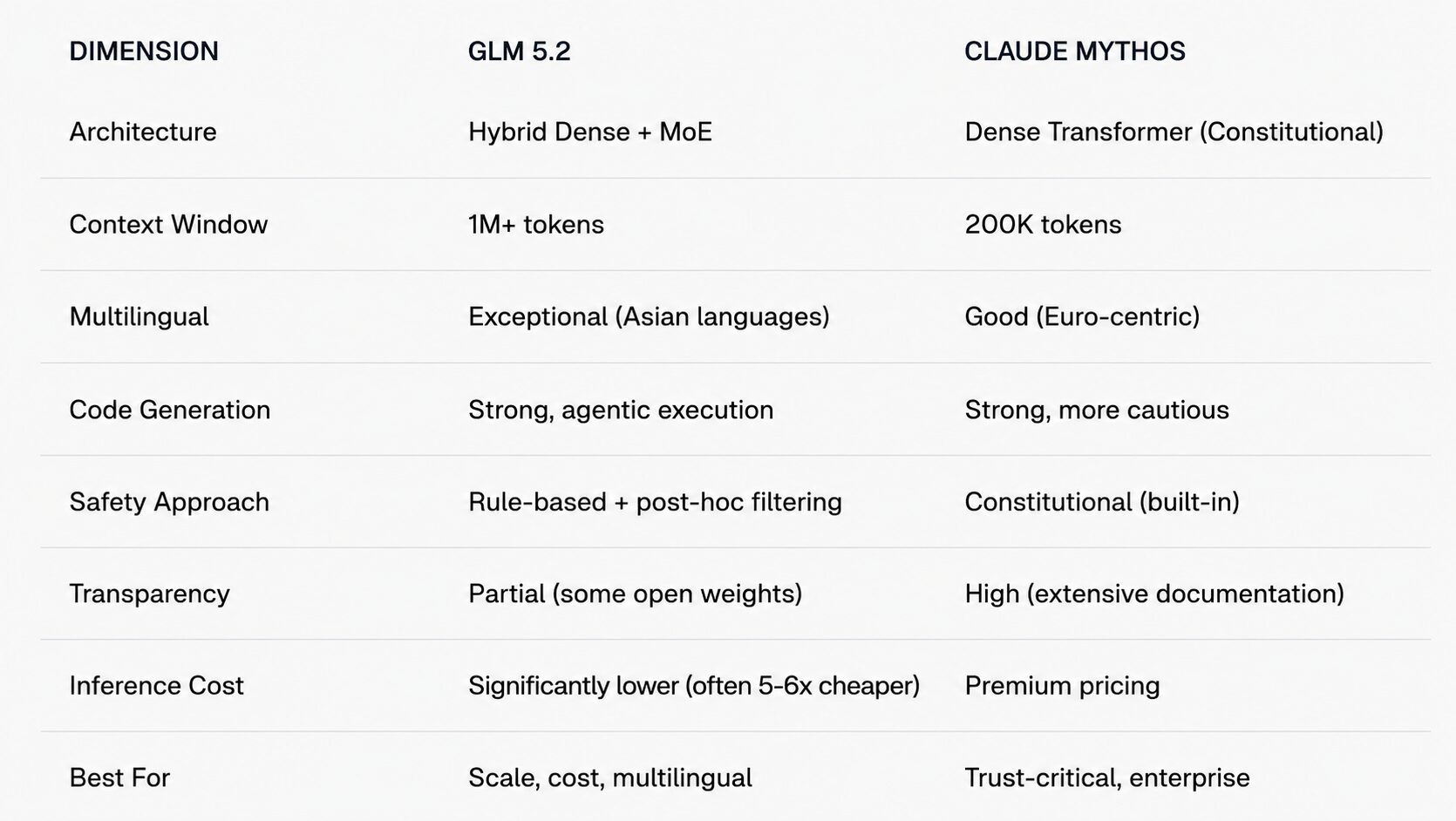
HEAD-TO-HEAD: GLM 5.2 VS CLAUDE MYTHOS
HOW CHATGPT’S LATEST FITS IN
OpenAI’s GPT-5 series remains a strong generalist with excellent multimodal capabilities. It serves as the default for many users needing seamless voice, vision, and broad ecosystem integration. GLM-5.2 often wins on cost and coding/long-context efficiency, while Claude Mythos excels in safety-critical and cybersecurity use cases.
Multimodal fluency is a fast-moving feature. The deeper differences in philosophy — capability and access (Z.ai), reliability and trust (Anthropic), and ecosystem experience (OpenAI) — are what will define the competitive landscape.
THE RISKS: WHAT KEEPS EXPERTS UP AT NIGHT
CAPABILITY OVERHANG
These models are released with capabilities that weren’t fully tested at scale. The gap between lab evaluation and real-world deployment creates an “overhang” of unknown risks that only manifest after millions of users interact with the system.
REGULATORY ARBITRAGE
Companies may route AI workloads to jurisdictions with the weakest safety requirements. GLM 5.2’s availability creates a potential “race to the bottom” where safety becomes a competitive disadvantage.
DEPENDENCY CREEP
As these models get embedded in healthcare, finance, and governance, we become dependent on systems whose failure modes we don’t fully understand. “Switch it off” becomes less viable over time.
INFORMATION ECOSYSTEM DAMAGE
Three competing AI systems generating high-quality content at scale means three different “realities” being constructed simultaneously. The shared factual ground that democratic discourse depends on erodes further.
LABOR DISRUPTION ACCELERATION
GLM 5.2’s low inference cost makes AI automation economically viable for tasks previously too expensive to automate. Rather than a distant possibility, workforce disruption is already unfolding across Southeast Asia and beyond.
GEOPOLITICAL WEAPONIZATION
When AI capability becomes a proxy for national power, safety cooperation becomes strategically irrational. The US-China AI dynamic is creating exactly this trap, where sharing safety research is seen as aiding a competitor.
WHAT THE WORLD CAN COMPREHEND SO FAR
Here’s an uncomfortable observation: most of the world — including most policymakers, most executives, and most journalists — does not meaningfully understand what these models are or what they do. And that comprehension gap is itself a risk.
General Public — ~15% comprehension
Understands “AI” as a buzzword. Cannot distinguish between models.
Policy Makers — ~30% comprehension
Understand regulatory frameworks. Struggle with technical specifics.
Tech Executives (Non-AI) — ~45% comprehension
Understand product implications. Overestimate their grasp of limitations.
AI Researchers — ~75% comprehension
Deep technical understanding. But even they can’t fully explain emergent behaviors.
Frontline Alignment Teams — ~85% comprehension
Closest to full picture. But they’re also the most aware of what they don’t know.
What the world does comprehend — and this is almost universal — is that AI is becoming more capable faster than expected. The GLM 5.2 release shattered the assumption that frontier AI capability was a US-exclusive club. That realization, more than any technical detail, is what’s driving the current anxiety.
The challenge is that comprehension is fragmented across three axes: technical understanding (what the model does), governance understanding (who controls it and how), and impact understanding (what it means for society). Most stakeholders are strong on one axis and weak on the other two.
(Note: Conceptual estimates based on industry observation rather than formal surveys.)
WHAT TECH LEADERSHIP MUST DO: A HUMAN-FIRST FRAMEWORK
The question isn’t whether these models will be deployed — they will. The question is whether the people deploying them will do so with intentionality. Here’s what responsible tech leadership looks like in this moment:
01 — MANDATE RED-TEAMING BEFORE REVENUE
Every deployment of GLM 5.2, Claude Mythos, or GPT-5 (Latest series) should require independent adversarial testing proportional to the stakes of the use case. Healthcare AI gets more scrutiny than recipe generators. This seems obvious but is almost never done in practice because it costs money and delays launches.
02 — BUILD “MODEL-AGNOSTIC” SAFETY LAYERS
Don’t trust any single model’s safety claims. Build your own guardrails — output filters, human-in-the-loop checkpoints, anomaly detection — that work regardless of which model is generating the content. Anthropic’s safety is Anthropic’s responsibility. Your safety is yours.
03 — INVEST IN AI LITERACY AT EVERY LEVEL
Not just “AI for executives” workshops. Actual, ongoing education for product managers, engineers, customer support, and end users about what these systems can and cannot do. The comprehension gap we discussed earlier is a leadership failure.
04 — DEFAULT TO HUMAN-AUGMENTED, NOT HUMAN-REPLACED
Every AI deployment should start from the question: “How does this make the human better at their job?” not “How does this replace the human?” If your AI strategy is primarily a cost-cutting strategy, you’ve already failed the human-first test.
05 — PARTICIPATE IN CROSS-BORDER SAFETY STANDARDS
The geopolitical dynamics we described are real, but they’re not an excuse for isolationism. Tech leaders should actively support initiatives like the AI Safety Summit process, the Frontier Model Forum, and academic cross-pollination — even when it means collaborating with competitors.
06 — CREATE MEANINGFUL ACCOUNTABILITY STRUCTURES
Not ethics washing boards. Actual accountability: named individuals responsible for AI outcomes, incident response plans that are tested (not just documented), and consequences — real ones — when AI systems cause harm. If your AI hurts someone and nobody loses their job, your accountability structure is theater.
WHERE THINGS ARE HEADING: THE NEXT 18 MONTHS
Based on current trajectories, conversations with researchers, and the strategic moves each player is making, here’s what I expect:
- The Price War
- Multimodal Catch-Up
- Agent Wars
- Regulatory Crunch
The most important thing happening in AI right now isn’t any single model release. It’s the fact that the three most capable AI ecosystems on Earth — US, China, and Europe — are developing fundamentally different visions of what AI should be. And they’re all going to be deployed on the same global internet.
The deepest tension is philosophical, instead of technical one. Should AI maximize capability and access (Z.ai’s implicit position)? Should it prioritize safety and alignment even at the cost of capability (Anthropic’s position)? Should it optimize for ecosystem lock-in and user experience (OpenAI’s position)?
There’s no clean answer. And the fact that there’s no clean answer is precisely why human-first leadership — the kind that acknowledges uncertainty, builds in humility, and treats safety as a continuous practice rather than a checkbox — is the only viable path forward.
FINAL THOUGHT
GLM-5.2 didn’t create the AI safety and governance challenge, but it has made it harder to ignore. The widening gap between rapidly advancing AI capabilities and the slower pace of governance, public understanding, and accountability has become increasingly difficult to overlook. Ultimately, the outcome will depend less on any single AI lab than on the choices made by technology leaders, policymakers, businesses, and the public as these systems become part of everyday life.
Our world needs Awakened Leadership and Awakened AI Governance to ensure the future belongs to humanity, not the other way around.
Pioneering Awakened Leadership & Governance
Humanizing Power, AI & Humanity’s Future
(Views expressed are personal. Not affiliated with Z.ai, Anthropic, or OpenAI.)