Somewhere right now, a lawyer is reviewing a contract. A financial analyst is building a model. A marketing manager is drafting a campaign brief. And somewhere else, an AI system is doing all three things simultaneously — faster, cheaper, and without a salary, a pension, or a moment of hesitation.The AI white-collar job disruption conversation has been filtered through layers of corporate diplomacy, political caution, and institutional denial for long enough. This report strips all of that away.
The questions asked here are uncomfortable because the answers demand accountability — from tech leaders, from governments, from economists, and from every professional still betting their career on the assumption that their degree makes them indispensable.
Suleyman’s 18-Month Statement: What It Actually Means
When the CEO of Microsoft AI speaks publicly about the timeline for automation, the world should pause and pay attention.
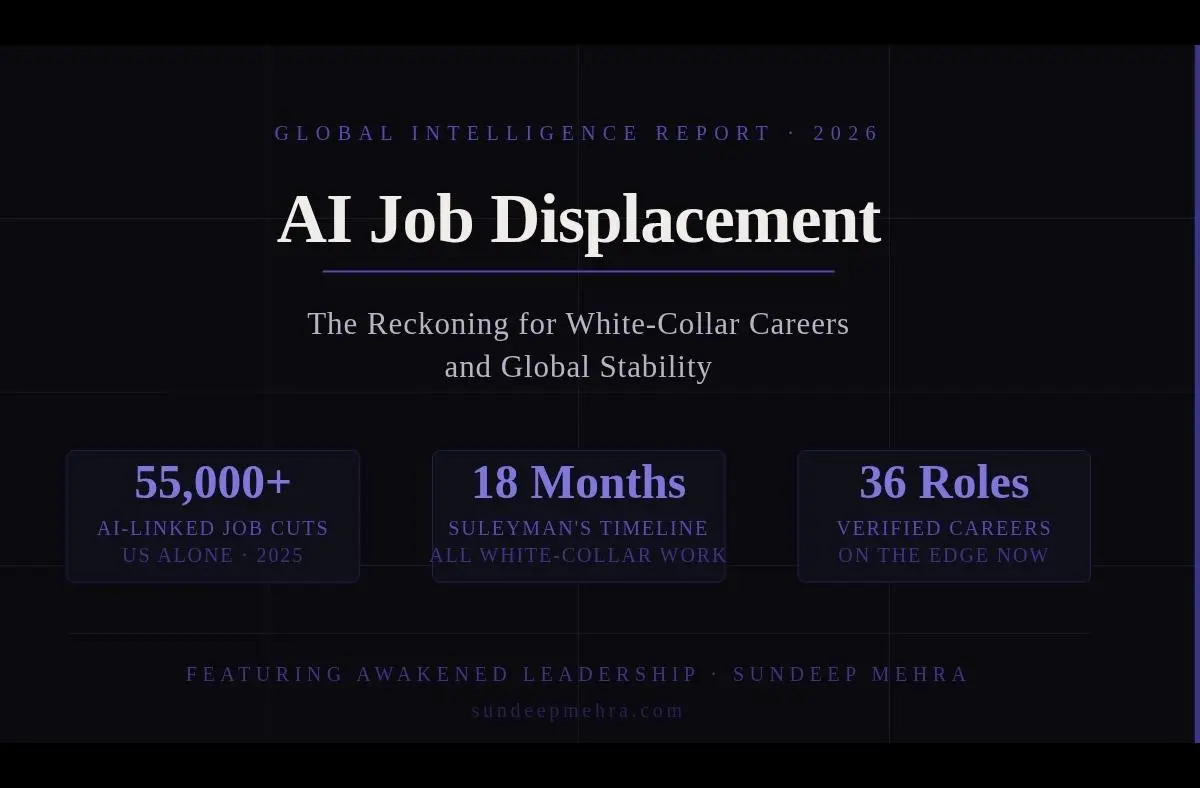
Mustafa Suleyman — co-founder of DeepMind and CEO of Microsoft AI — stated in a widely reported interview that AI will reach “human-level performance on most, if not all, professional tasks” within 12 to 18 months. He named accounting, legal work, marketing, and project management as the roles most vulnerable to near-term automation.
This was not a startup founder chasing headlines. Suleyman described a future where creating a custom AI model becomes as simple as writing a blog post, and where “it will be possible to design an AI that suits your requirements for every institutional organisation and person on the planet.”
Anthropic CEO Dario Amodei offered a longer five-year runway — but still warned that AI could wipe out half of all entry-level white-collar jobs. Ford CEO Jim Farley predicted AI would cut white-collar employment in the US by half. These are not fringe voices. These are the architects and leaders of systems already in deployment.
The direction, regardless of exact timeline, is settled.
36 Careers on the Edge: A Verified Breakdown
The disruption unfolding across professional sectors follows one consistent pattern: the volume of humans required to perform high-value cognitive work is collapsing, even when the work itself continues. The organisational pyramid is inverting. Where fifty professionals once operated, five will oversee.
The following 36 roles represent the most documented, most widely recognised, and most immediately affected careers in the current wave of AI white-collar job disruption.
Technology & Data
1. Software Engineers — AI coding tools including GitHub Copilot and Claude already generate production-level code. Senior engineers increasingly review and direct AI output rather than write from scratch. Entry-level coding roles are disappearing fastest.
2. Data Scientists — Automated machine learning platforms now handle model selection, feature engineering, and performance evaluation autonomously. Tasks that once required specialist teams are executed by tools accessible to non-specialists.
3. Cybersecurity Analysts — AI threat detection systems scan entire networks continuously, identifying and responding to intrusions in milliseconds. Human analysts are shifting toward governance and exception management rather than frontline detection.
4. Cloud Architects — Infrastructure-as-code and AI orchestration tools now handle configuration, scaling, and optimisation — functions that previously justified dedicated specialist roles.
5. Product Managers — AI product discovery platforms synthesise user research, competitive intelligence, and roadmap prioritisation simultaneously. The role of coordinator between data and decision is being automated at its core.
Finance & Accounting
6. Chartered Accountants and Auditors — AI audit platforms process financial records with speed and consistency that human reviewers cannot match. Goldman Sachs has projected that AI could expose 300 million full-time jobs globally to automation — a wave in which back-office finance and entry-level accounting roles are among the most immediately documented categories.
7. Financial Risk Analysts — Algorithmic risk models process thousands of variables in real time across market conditions, geographies, and regulatory environments simultaneously — a task beyond any human team’s bandwidth.
8. Investment Banking Analysts — AI due diligence tools condense weeks of merger and acquisition analysis into hours. Junior analyst roles — historically the entry point into investment banking — are the most immediately at risk.
9. Actuaries — Probabilistic AI models trained on decades of insurance and mortality data now generate risk assessments across multiple product lines simultaneously, outpacing classical actuarial methods on speed and scope.
10. Financial Advisors — Robo-advisors globally manage over $2 trillion in assets as of 2025, according to Statista market data, delivering personalised, tax-optimised investment strategies at a fraction of traditional advisory fees.
Legal & Compliance
11. Corporate Lawyers — AI contract review tools scan thousands of pages in seconds, flagging anomalies, risks, and regulatory conflicts that junior associates would take days to identify. Document-heavy legal work is among the most exposed of any profession.
12. Compliance Officers — Regulatory AI monitors policy changes across jurisdictions in real time and maps them against internal processes automatically — a function that previously required entire compliance departments.
13. Intellectual Property Analysts — Natural language processing tools now conduct patent landscape analysis, prior art searches, and trademark monitoring at volumes and speeds that manual IP research cannot approach.
Marketing & Communications
14. Digital Marketing Directors — AI campaign management platforms autonomously optimise advertising spend, creative assets, and audience targeting across channels in real time, compressing functions that once required full teams.
15. Public Relations Specialists — AI tools now generate media monitoring summaries, draft press releases, model crisis scenarios, and track sentiment across thousands of publications simultaneously.
16. Content Strategy Managers — Generative AI produces, schedules, personalises, and A/B tests content pipelines at scale. The strategic oversight role remains, but the execution layer beneath it is largely automated.
17. Market Research Analysts — AI platforms design surveys, synthesise consumer data, identify patterns, and generate insight reports — compressing a function that agencies once billed months to deliver.
Corporate Management & Operations
18. HR Directors — AI recruitment screening, candidate ranking, employee sentiment analysis, and onboarding automation are restructuring HR departments from strategic functions into oversight roles with smaller headcounts.
19. Management Consultants — AI strategy platforms synthesise industry benchmarks, operational data, and scenario modelling at a speed and scale that compress the core deliverable of traditional consulting engagements.
20. Project Managers — AI project management platforms track task dependencies, flag schedule risks, reallocate resources, and generate status reports without human prompting — functions that defined the project manager role for decades.
21. Supply Chain Managers — AI demand forecasting and logistics optimisation tools process global variables — weather, geopolitics, supplier reliability, consumer trends — simultaneously. The restructuring of global supply chains by AI is already documented and ongoing.
22. Operations Managers — AI process automation platforms now handle workflow scheduling, resource allocation, and performance monitoring across entire business units. The operational coordination role is being absorbed into systems rather than people.
23. Business Analysts — AI process mining tools map organisational inefficiencies, model restructuring options, and generate recommendations without the interviews, workshops, and weeks of analysis that traditional business analysis required.
24. Procurement Specialists — AI vendor analysis tools evaluate supplier performance, benchmark contract terms, and flag risks across global procurement networks in real time, replacing functions that entire procurement teams once handled manually.
Healthcare & Science
25. Healthcare Administrators — AI scheduling, billing, resource allocation, and compliance reporting systems are measurably reducing administrative headcounts across hospital networks globally.
26. Radiologists — Peer-reviewed research published in 2025 across PubMed and leading radiology journals confirms that AI imaging tools now match or surpass experienced radiologists on specific cancer detection tasks in controlled clinical studies, including breast, lung, and prostate cancer identification. The FDA had authorised nearly 1,000 AI-enabled radiology devices by mid-2025 — approximately 77% of all medical AI device approvals — reflecting the scale and speed of this transition.
27. Medical Coders and Clinical Documentation Specialists — AI natural language processing tools extract diagnosis codes, procedure codes, and clinical documentation from physician notes automatically — a function that entire medical coding departments exist to perform.
Research & Specialist Roles
28. Quantitative Analysts — AI trading models trained on decades of market data generate and test financial strategies at computational speeds no human quant team can replicate. The competitive edge that quant roles once offered is narrowing rapidly.
29. Database Administrators — AI-driven database optimisation, automated query tuning, and self-healing database architectures are reducing the need for dedicated DBA roles across enterprise technology stacks.
30. ERP Consultants — AI integration platforms are automating the configuration and customisation of enterprise resource planning systems — work that commanded premium consulting rates for decades.
31. Systems Analysts — AI-powered systems design tools now map organisational requirements, generate architecture recommendations, and produce technical specifications with minimal human input.
Leadership-Adjacent & Specialist Support
32. Corporate Trainers — Adaptive AI learning platforms deliver personalised training at scale, adjusting content and pace to individual learners in real time. The human facilitator role is becoming optional in most corporate training contexts.
33. Technical Writers — AI tools generate user manuals, API documentation, and compliance documentation from source material directly. The technical writer role is among the most immediately and extensively disrupted by generative AI across corporate and technology environments.
34. Change Management Specialists — AI organisational modelling tools simulate transformation outcomes, model resistance scenarios, and generate communication strategies before costly change programmes launch.
35. UX Designers — AI interface generation tools now produce functional design prototypes directly from text prompts. While senior UX strategy remains human-led, the execution layer is compressing rapidly.
36. Customer Success Directors — AI relationship management platforms monitor client health scores, flag churn risks, generate outreach recommendations, and personalise engagement at scale — collapsing the traditional customer success function into a supervisory role.
The common thread across all 36 careers is not that the work disappears overnight. The work continues. What collapses is the number of humans needed to perform it. The organisational pyramid inverts. Where there were fifty, there will be five. Where there were five, there may be one — and that one will spend their working hours supervising AI, not practising their profession.
The Numbers Behind the Disruption
The job losses are no longer hypothetical.
In 2025, AI was directly linked to nearly 55,000 job cuts in the United States alone, according to consulting firm Challenger, Gray & Christmas. AI was cited in nearly 28,000 additional job cuts in the opening months of 2026, according to the same firm. Major corporations including Amazon, Salesforce, and Microsoft cited AI as a contributing factor in their workforce reductions.
Anthropic’s own CEO projected US unemployment could reach as high as 20% as a consequence of AI-driven white-collar displacement within five years. These are not figures from alarmist blogs — they come from filings, earnings calls, and published forecasts.
Meanwhile, a Yale Budget Lab report from October 2025 concluded that the broader labor market has not experienced a discernible disruption since ChatGPT’s public launch in late 2022. That lag is precisely the danger. History shows that technological disruption moves in waves — the surface appears calm until structural collapse happens faster than adaptation systems can respond.
May 2026: The Month the Numbers Stopped Being Abstract
If there was any remaining doubt that AI-driven workforce restructuring had moved from forecast to operational reality, May 2026 removed it decisively.
In the first ten days of May alone, nearly 38,000 jobs were cut across US companies, according to documented announcements. The pace, the scale, and the language used by executives marked a clear departure from previous cycles of restructuring.
- Cloudflare eliminated approximately 1,100 roles — roughly 20% of its entire global workforce — on May 7, 2026. The cuts were filed with the SEC and the company’s own communication to staff stated the move was designed to “accelerate its evolution to an agentic AI-first operating model.” What makes this particularly striking: Cloudflare simultaneously reported 25% revenue growth and disclosed that internal AI usage had jumped over 600% in three months. This was not a company in distress cutting to survive. This was a growing company cutting because AI had structurally reduced its human headcount requirements.
- PayPal announced plans to eliminate approximately 4,760 roles — 20% of its 23,800-person workforce — phased over two to three years, explicitly linking the reduction to AI-powered automation across customer support, compliance, and backend financial operations.
- Coinbase cut roughly 700 employees — 14% of its staff — with CEO Brian Armstrong framing the decision as a structural shift toward smaller, AI-augmented teams and describing the company’s goal of becoming “AI-native.”
- BILL announced headcount reductions of up to 30%, citing acceleration of AI adoption across its operations.
- Upwork — a platform whose entire business model was built on connecting human freelancers with companies needing work done — cut 24% of its own workforce on May 7, the same day as Cloudflare. The platform built for human work is restructuring around AI.
- Freshworks cut approximately 500 roles — 11% of its workforce — on May 5, citing AI efficiency gains.
- LinkedIn, Ticketmaster, ZoomInfo, and Arctic Wolf also announced cuts during the same period. Arctic Wolf confirmed 250 roles eliminated on May 6, explicitly redirecting funds toward its AI-powered Aurora Superintelligence platform. LinkedIn, Ticketmaster, and ZoomInfo are confirmed in the Crunchbase weekly layoff tracker for the week ending May 14, 2026, though specific headcount figures were not publicly disclosed by those companies.
By mid-May 2026, the global technology sector had already lost over 108,000 jobs in 2026 alone, according to tracked announcements.
Meta confirmed on May 20, 2026 that approximately 8,000 employees — 10% of its entire global workforce — would be cut in a single companywide restructuring round, with an additional 6,000 open roles cancelled simultaneously. This arrived not during a financial downturn but alongside record quarterly revenue of $56.31 billion. Meta simultaneously announced AI infrastructure spending of up to $145 billion in 2026. Further rounds of cuts are reported but not yet finalised for the second half of 2026.
The pattern across every May announcement shares one common architecture: companies are not cutting because business is failing. They are cutting because AI has changed the ratio of humans required to deliver the same or greater output. Revenue is growing. Headcount is shrinking. The gap between the two is being filled by AI systems.
That is not a prediction. That is a May 2026 earnings call.
The Humanoid at the Door
The AI white-collar job disruption conversation has focused almost entirely on software. The hardware dimension has barely entered public consciousness — and that is the next wave.
Tesla’s Optimus humanoid robot program has moved from prototype to production reality. As of early 2026, Tesla had deployed over 1,000 Optimus Gen 3 humanoid robots across its manufacturing facilities in Gigafactory Texas and Fremont, California. These machines are deployed on factory floors performing tasks including parts sorting, kitting, and data collection — primarily serving as real-world AI training platforms as Tesla scales toward full autonomous operation.
Tesla’s first production line — designed for one million robots per year — is being installed at Fremont in 2026, with production start targeted for late 2026, replacing the Model S and Model X lines specifically to manufacture Optimus at scale. Gigafactory Texas is being prepared for a second production line with an eventual target of ten million units annually.
Elon Musk called Optimus “the biggest product of all time,” reasoning that if capable humanoid robots can be manufactured at a targeted $20,000–$30,000 per unit, every task that currently requires a human body becomes economically automatable.
When the body of work follows the brain of work into automation, the equation for employment changes permanently. White-collar roles face the first wave. Blue-collar and service sectors — previously considered safe from AI — face the next.
Musk’s Promise: Universal High Income or Philosophical Void?
At the Viva Technology conference in 2024, Elon Musk articulated what he described as the benign scenario: a world where “probably none of us will have a job,” where “there will be universal high income — not universal basic income — universal high income,” and where there will be “no shortage of goods or services.”
Musk estimated an 80% probability of this outcome, and has since pushed the concept further — arguing that money itself may eventually “stop being relevant,” and that poverty will be eliminated.
The vision is sweeping. The plan is absent.
“When the entire architecture of civilization — its economies, its governments, its meaning-making systems — was built on the premise of human labor, a post-labor world cannot be improvised. It must be designed. And it must be designed by awakened leaders who understand what they are building.”
— SunDeep Mehra, Pioneering Awakened Leadership and Governance
Economists note several unresolved tensions in the universal high income framework. Energy demand scales with AI and robotics adoption — the substitution of human metabolic output with electrical and computational power requires an energy infrastructure that does not yet exist at the required scale. The political will to fund, legislate, and distribute universal income remains entirely unproven. And even if abundance arrives materially, Musk himself admitted the deeper crisis: “The question will really be one of meaning.”
What happens to human identity, purpose, and psychological health in a world where the primary organizing framework of modern civilization — paid work — dissolves?
That question has no market solution. It demands awakened governance. It demands wisdom. It demands precisely the kind of awakened leadership that most current systems are structurally incapable of producing.
AI as a Weapon: Surveillance, Targeting, and the Weaponization of Intelligence
The most dangerous dimension of the AI disruption story is the one receiving the least scrutiny in mainstream discourse.
Governments are not merely adopting AI to improve services or efficiency. They are deploying it as a weapon of control — against their own populations.
China’s Surveillance Architecture
Leaked internal guidelines for China’s 2026 “Two Sessions” political meetings exposed a surveillance system that would have seemed dystopian fiction a decade ago. The system deployed AI-powered facial recognition, real-time phone tracking with 10-second geolocation alerts, drone patrols covering every highway service area and long-distance bus station approaching Beijing, and blockchain-recorded suppression agreements. The stated objective was “zero petitioners reaching Beijing” — citizens with legitimate grievances, blocked by an AI-powered apparatus from even reaching the buildings where decisions are made.
This is not an aberration. China’s “Safe City” framework has exported this surveillance architecture to dozens of countries across Africa, Southeast Asia, Central Asia, Latin America, and the Middle East — building a global infrastructure of AI-enabled authoritarian control.
Chinese AI firms now appear on the US Department of Commerce’s Entity List for providing facial recognition systems used to target Uyghur populations in Xinjiang. The same technology, built by companies whose revenues fund further AI development, is now woven into the civil infrastructure of governments that purchased it for “public safety.”
The United States: A Different Kind of Opacity
The US posture on AI surveillance carries its own contradictions. In November 2025, the FBI issued a procurement request seeking AI and machine learning capabilities for drone systems that could perform facial recognition, license plate recognition, and weapons detection. Civil liberties organizations described the technology as “tailor-made for political retribution and harassment.”
US lawmakers attempted four times since September 2024 to close a loophole allowing China to access banned high-performance American AI chips through US cloud services — all four failing under tech industry lobbying pressure. The House subsequently passed the Remote Access Security Act in early 2026 to address the gap, though implementation and enforcement remain contested.
Meanwhile, in active conflict zones, AI-assisted targeting systems have contributed to civilian casualties. AI errors in identifying militants have informed strikes that killed non-combatants. Facial recognition failures contributed to wrongful arrests. The gap between the capability of these systems and the ethical frameworks governing their use is not a technical problem. It is a leadership problem.
When AI Went to War: The Pentagon, Palantir, and the Claude Confrontation
In January 2026, US special operations forces captured Venezuelan President Nicolás Maduro in Caracas. Eighty-three people were killed in the operation, including 47 Venezuelan soldiers. What emerged in the weeks that followed was as significant as the operation itself: Anthropic’s Claude — deployed through its partnership with Palantir inside the Pentagon’s classified networks — had been used during the active military operation.
Anthropic had not sanctioned this use. An Anthropic executive contacted Palantir directly to ask whether the technology had been used in the raid.
The confrontation that followed exposed the raw mechanics of how artificial intelligence is being weaponised by governments operating at the edge of — and beyond — their own legal and ethical frameworks.
The Pentagon demanded Anthropic agree to allow Claude to be used for “all lawful purposes” — a framing that Anthropic understood to include fully autonomous lethal weapons systems that fire without human oversight, and mass domestic surveillance of American citizens. These were Anthropic’s two stated red lines. The company refused to remove them.
President Trump ordered every federal agency to immediately cease using Anthropic’s technology. Defense Secretary Pete Hegseth designated Anthropic a “supply chain risk” — a classification historically reserved for foreign adversaries like Huawei — effectively blacklisting the company from military and intelligence contracting. The Pentagon threatened to force all military contractors to cut ties with Anthropic entirely.
Anthropic sued the federal government in two courts simultaneously. A federal judge found the Pentagon’s actions “troubling” and questioned whether the supply chain risk designation was legally justified. In March 2026, a preliminary injunction was granted blocking the government from enforcing its ban — a ruling the government subsequently challenged.
Meanwhile, Claude was confirmed as having been used in US strikes during the Iran conflict in early 2026 as well, integrated into the Pentagon’s Maven Smart System. With AI language models integrated into targeting workflows, the US military was processing five times as many targets per day.
The other major AI companies drew their own conclusions from watching this confrontation. Google dropped its pledge not to develop AI for weapons. OpenAI removed “safety” as a core value from its mission statement. Elon Musk’s xAI agreed to the Pentagon’s “any lawful use” standard without objection.
One company held its line. Every other major AI provider moved toward the Pentagon’s position.
The gap between the capability of these systems and the ethical frameworks governing their use is not a technical problem. It is a leadership problem — and the leadership of the world’s most powerful governments has already demonstrated which side of that gap it stands on.
Exposing the Architects: Leaders Without Awareness
There is a specific kind of danger in the current AI landscape that has nothing to do with the technology itself. It lives in the boardrooms and policy chambers of the people directing it.
The AI dominance race between the United States and China runs on the oldest forces in human civilization: competitive fear, geopolitical positioning, and the consolidation of power.
Tech leaders compete to release the most capable systems before adequate safety testing exists. Governments race to weaponize AI capabilities before governance structures are established. Investors optimize for exponential returns on capital while asking no meaningful questions about systemic social consequences.
These are not the behaviors of people who have reckoned with what they are building.
The irony is profound: the most consequential technological development in human history is being steered predominantly by individuals who are psychologically, philosophically, and ethically unequipped for the weight of that responsibility. Many possess extraordinary technical intelligence and almost no wisdom. They can articulate the capability of AI systems in detail while remaining entirely unconscious of their own motivations, their own fears, and the civilizational consequences of the choices they make at speed.
The argument here is simple: the people directing AI development must evolve to meet the scale of what they are building.
Awakened Leadership and Governance: The Only Coherent Path Forward
SunDeep Mehra’s pioneering work on Awakened Leadership and Awakened Governance — developed through years of discernment, philosophical inquiry, and global engagement with awakened clarity— offers the most coherent framework available for navigating the civilizational threshold humanity is crossing.
Awakened Leadership, as Mehra defines it, demands leadership rooted in awakened consciousness, he calls it leadership awakening — in the capacity to see clearly, act with integrity, and hold the full complexity of consequences without flinching — expressed through the Awakened Leadership Model, Decision Framework, and a growing ecosystem of leadership and governance tools. Dominance, accumulation, and technical expertise alone produce the architects already examined in this report.
Awakened AI Governance reframes the entire governance conversation. Where current approaches treat AI regulation as compliance — rules imposed on systems from outside — Awakened AI Governance places the consciousness of the leader as the primary governance instrument. Policies will always lag behind technology. Leaders who lack inner clarity will always find ways around policies. The only governance mechanism that can match the speed of AI development is the depth of awareness of the people directing it.
The Awakened Governance framework comprising Political Governance, Global Governance, AI Governance, and Awakened Diplomacy, addresses the structural question: how do societies design systems capable of holding power without being corrupted by it? How do institutions evolve fast enough to remain meaningful when the technological substrate of civilization changes faster than any legislature can deliberate?
These are urgent operational questions — and the absence of credible answers in current global governance represents the single greatest civilizational risk of this era, exceeding even the technological risk of AI itself.
What This Means for Professionals, Nations, and Societies
For the professional currently employed in any of the 36 roles outlined in this report, the question is not whether disruption is coming. The question is how to position consciousness — not just skills — ahead of it.
AI capabilities are expanding weekly. The professionals who endure are those who can hold what AI structurally cannot hold: judgment rooted in embodied experience, ethical accountability, relational depth, and the capacity to ask the questions that no algorithm has been trained to ask.
For nations and governments, the window for proactive policy is narrowing with every quarter of AI development that passes without legislative clarity. Universal high income, healthcare systems redesigned for a post-employment society, educational frameworks that prepare populations for meaning rather than merely for jobs — none of these can be improvised in a crisis. They must be built during the transition.
For societies and cultures, the deepest work is philosophical and internal. Every major civilization has organized itself around some framework of meaning. For the modern world, that framework has been work — the dignified exchange of human effort for sustenance and status. When that framework dissolves, societies need a replacement of equivalent depth. Consumption is not meaning. Entertainment is not meaning. The absence of suffering is not flourishing.
The Opportunity: Joining the Global Awakening
The Awakened Leadership Movement pioneered by SunDeep Mehra represents one of the few genuine responses to this civilizational moment that operates at the required depth.
The Awakened Leadership Movement builds rather than protests — constructing the inner architecture of leadership that can hold the outer complexity of AI, governance, and civilizational transition without collapsing under its weight.
The movement calls on individuals across every sector — technology, policy, law, medicine, education, finance, civil society — to undertake the work of becoming genuinely awake to their own power, their own blindspots, and their own responsibility within the systems they inhabit.
The world needs leaders who carry their technical capability inside a larger container of wisdom, ethical clarity, and genuine concern for the civilizational whole — leaders for whom brilliance and humanity are inseparable.
The invitation is open. The work is at sundeepmehra.com. Join the Global Leadership Awakening.
The most important AI disruption of the coming decade runs deeper than the replacement of accountants, lawyers, or project managers. Hollow leadership itself faces replacement — with something humanity has been trying to build for millennia, and has never needed more urgently than now.