
On April 24 and 25 of 2026, identical emails arrived from the White House Presidential Personnel Office.
Every member of the National Science Board received the same message.
Positions terminated. Effective immediately. On behalf of President Donald J. Trump.
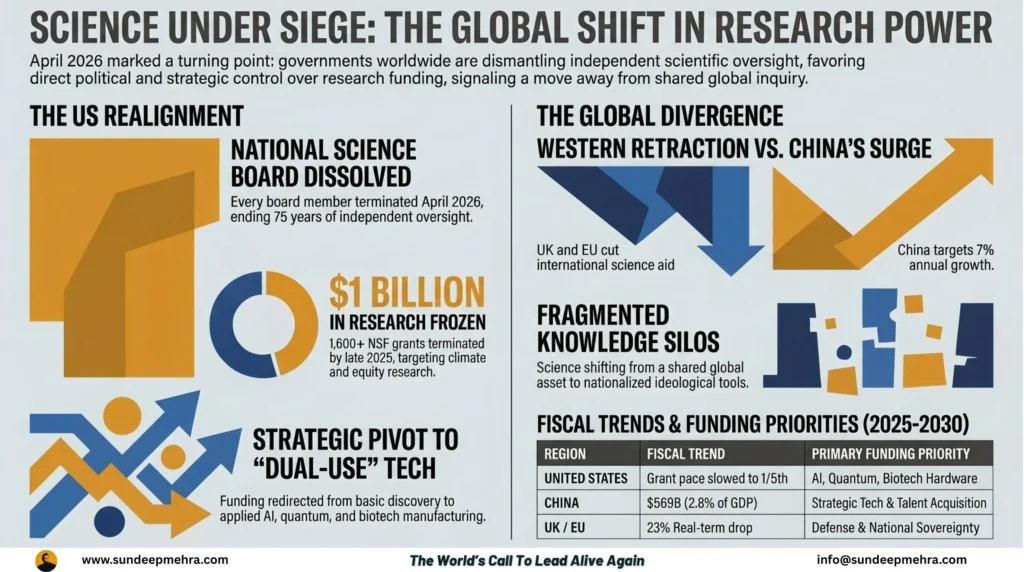
This NSB firing — all 24 members terminated in a single day — sent shockwaves through the scientific community.
The board — scientists, engineers, and policy veterans serving staggered six-year terms under the 1950 NSF Act — existed to shield basic research from election swings. That protection disappeared overnight.
The National Science Foundation, which channels nearly $9 billion yearly into foundational discovery, now stands without its guiding oversight body.
This moment captures science under siege.
Events like this one do not stand alone.
They form part of a wider shift visible in capitals around the world. Governments across ideologies tighten their hold on the very institutions built to protect long-term inquiry. Budgets for patient, curiosity-driven work shrink or redirect. Advisory panels clear out or lose influence. Evidence-based counsel yields ground to pressing political, fiscal, or strategic demands.
The Broader Landscape in Sharp Relief
Since the start of 2025, the United States has seen thousands of active research grants terminated or frozen across federal agencies. This wave of global research funding cuts is not limited to America.
At the NSF alone, more than 1,600 awards worth over $1 billion disappeared by late 2025. Many carried language or themes linked to diversity, equity, inclusion efforts, climate-related social science, or equity framing.
Similar waves swept through the NIH.
New awards slowed dramatically. By early 2026, the NSF handed out grants at roughly one-fifth the pace of recent years.
Elsewhere the pressures mount differently.
The United Kingdom steers official development assistance down to 0.3 percent of gross national income by 2027–28 — the lowest share in decades — so funds can shift toward defense. Science-related international partnerships feel the pinch.
Across the European Union, development assistance dropped more than 23 percent in real terms in 2025.
China recorded R&D spending of 3.92 trillion yuan — roughly $569 billion, or 2.8 percent of GDP — in 2025. Basic research crossed 7 percent of the total for the first time. Official plans call for at least 7 percent annual growth through 2030. Beijing channels resources openly toward strategic technologies and draws foreign talent inward.
The United States stepped away from more than 60 multilateral bodies, conventions, and treaties in early 2026. These include the UNFCCC, IPCC, IPBES, and others tied to climate, biodiversity, and global scientific coordination.
These exits, presented as reclaiming sovereignty, removed a major contributor and convener from collaborative spaces.
Analyses from the Stimson Center and similar policy trackers highlight the converging pressures: debt and defense crowding out long-term investment, nationalist lenses reshaping research agendas, and a growing preference for domestic or ideological goals over open knowledge networks.
Inside the NSB Decision: What the Record Shows and What Lingers Beneath
No public record points to scandal, mass resignation, or outright defiance by the board.
Yet the administration clearly saw misalignment.
Policy insiders and former officials note that NSF grant language under the board’s watch steadily elevated diversity, equity, and inclusion alongside climate-focused social science and research framed around systemic inequities.
Conservative voices in Congress and think tanks argued for years that these priorities pulled resources from core competitiveness, national-security technologies, or discoveries delivering direct benefits to American industries and workers.
Quiet conversations in congressional corridors and off-the-record briefings add texture.
Some suggest board members quietly pushed back against the depth of budget reductions previewed by the White House.
Others sense the NSF portfolio had settled too comfortably into topics now viewed as ideological overhead.
A larger strategic bet may sit in the background: clearing space so new appointees can steer funds toward applied advances in AI hardware, quantum systems, and biotech manufacturing — fields where China’s state capital moves fast and where U.S. private industry still holds advantages but needs quicker public support.
Whispers circulate about calculated trade-offs: tighter visas, evaporating grants, and a possible brain drain that some hawks accept as the cost of realignment.
From the administration’s perspective, the board may have come to represent a federal science system that felt increasingly removed from ordinary American realities — rising living costs, job shifts in traditional sectors, energy security, border concerns.
Grants touching race, gender, or systemic framing struck critics as tilting the scales away from pure merit or subsidizing activism instead of innovation.
None of these considerations appear in the termination letters. They surface instead in leaked previews, the pattern of earlier 2025 advisory-panel clear-outs, and the broader commentary.
The quiet tension remains: will the reset unlock measurable breakthroughs in targeted areas, or will it simply dampen inquiry, speed talent away, and create openings that other nations fill on their terms?
“Silencing the guardians of discovery hands tomorrow’s breakthroughs to whoever holds the purse strings today.”
— SunDeep Mehra
Why Real Prosperity Keeps Slipping Away
Nations everywhere struggle because of a shared mindset that treats governance as a short-term contest rather than patient stewardship — the kind of Awakened Governance we urgently need.
Debt burdens built up after the pandemic now squeeze moonshot investments.
Election cycles reward division and grievance over steady institution-building.
Corporate pressures favor quarterly gains while citizens respond to slogans of sovereignty or greatness that often conceal deeper extraction.
Even established democracies show monarchical reflexes — power protecting itself through centralized control, elevated war budgets, and the quiet plundering of future potential.
Diplomacy slips into transactional exchange.
Education, business, and culture echo the same impatience: credentials over wisdom, virality over ethics, extraction over renewal.
Sustainable growth fades when metrics centered on human health, opportunity, and resilience lose ground to military outlays, elite capture, or ideological litmus tests.
Artificial hopes rush in to fill the void — narratives built on manufactured scarcity, division, and futures dressed in hate or greed.
Moments like the NSB shift, and their echoes abroad, expose how power can run unchecked once independent voices lose their seat at the table.
The Road Ahead: Near-Term Moves and Longer Shadows
In the days and months immediately ahead, further board replacements, grant reviews, and portfolio freezes seem likely.
Talent will quietly explore exit paths — toward countries still open to discovery or private spaces that can absorb the gap.
Over five to ten years, measurable lags could surface in patents, health outcomes, and living standards if the direction holds.
Innovation may cluster in narrower, dual-use domains while broader human-benefit research slows.
Global challenges around pandemics, biodiversity, and energy transitions grow harder to confront without shared evidence.
The deeper risk lies in fragmentation: science sliced into national or elite silos rather than a common knowledge base that once raised living standards worldwide.
Lessons That Matter, Impacts That Ripple, Dangers That Demand Attention
Independent, merit-based bodies serve as a kind of immune system for civilization, guarding against the pull of immediate advantage.
When they weaken, societies lean toward older, more feudal patterns — rich in rhetoric, thinner in genuine wealth.
Leadership loses credibility when facts bend to control.
Governance drifts from everyday human flourishing.
Societies nurture cynicism.
Businesses and schools turn cautious or captured.
Technology tilts toward surveillance and narrow leverage instead of broad liberation. Work and culture narrow.
Dangers call for clear-eyed focus right now:
- Quiet loss of talent and shared knowledge
- Science turned into a tool without ethical anchors
- Environmental and health thresholds ignored
- Authoritarian habits dressed as efficiency
- Generational handover of debt, division, and smaller horizons
These dangers grow sharper with every passing month.
Questions Worth Pausing For
Leaders, nations, systems, societies, and individuals might usefully step back and ask themselves:
Are we truly investing in the future we claim to value, or simply feeding the stories that win today’s attention?
At what point did safeguarding institutions become confused with shielding those already inside them?
If every capital begins choosing winners before the contest even starts, who ultimately pays the price — our children, the shared climate, or the very notion that knowledge can belong to all?
What trade-offs feel worth making today for a tomorrow that actually holds?
Where might control have quietly replaced genuine strength?
A Practical Path: Awakened Leadership
Awakened leadership offers the practical route history has shown actually works.
It rests on transparent measures of success, institutions protected yet answerable, and diplomacy that treats science as a shared global asset rather than a trophy.
Such leadership demonstrates humility and steady long-term vision.
Businesses step up to nourish common R&D spaces.
Education cultivates critical thought and ethical grounding.
Cultures learn to honor cooperation.
Individuals insist on evidence instead of slogans.
This kind of awakening reaches every sphere — governments rebuilding independence with openness, corporations channeling innovation toward lasting value, schools preparing people for humane work in an AI-shaped world, societies knitting unity through shared human promise.
The NSB moment and its wider echoes mark one chapter in an unfolding account.
How the world answers — through knee-jerk nationalism or deliberate, evidence-rooted stewardship — will decide whether the coming decade delivers shared abundance or splintered decline.
The evidence sits plainly before us.
The decision still rests with us all — collectively — to move toward global leadership awakening or stay inside the old cycle.
Those who choose stewardship may earn their place as the figures who finally aligned power with truth, compassion, courage, and the longer human story.
Others risk fading into footnotes of what might have been.
The future of civilization, meaningful work, thoughtful leadership, and our common humanity now turns on that balance.
What are your thoughts?
How do you see this science under siege playing out in your country, your work, or your community?
Share your perspective in the comments below.
Your voice matters in shaping the awakened leadership and future of scientific discovery we need.
Pioneering Awakened Leadership and Governance
Keynote Speaker & Advisor to Governments, Institutions & Global Leaders on AI Ethics, Power & Humanity’s Future