
UAE Quits OPEC & OPEC+ — effective May 1, 2026. This decision carries weight far beyond the headlines.
It marks a seismic shift in oil geopolitics, unfolding against the backdrop of the Iran war and a Strait of Hormuz already strained by conflict. Markets may appear calm on the surface, but the move quietly reshapes power balances across the Middle East and global energy flows.
What stands out most is the picture it paints of leadership in our time.
We see a clear shift playing out — from any remaining commitment to “We First” toward an open and unapologetic “Me First.”
Short-term gains now sit firmly above long-term visionary strategy. In place of Awakened Leadership, we witness a growing chase for unchecked domination and immediate national advantage.
This moment pulls the curtain back on something larger.
If long-time partners in one of the world’s most powerful cartels can part ways with so little hesitation, it forces us to ask: How stable are other alliances we assume will hold? What quiet calculations are leaders making right now in boardrooms and capitals around the world?
The more closely you examine this exit, the more it reveals about the deeper currents shaping our era — and why every leader, nation, and society should pay close attention to what comes next.
The Perfect Window
The Strait of Hormuz was already crippled by ongoing conflict. Iranian threats had severely disrupted shipping routes, effectively capping export flows for everyone in the region. In such a tense environment, the UAE’s departure from OPEC created almost no immediate shock in the global oil markets.
Abu Dhabi saw a rare opportunity and seized it.
Now free from quota restrictions, the UAE can pursue its ambitious target of 5 million barrels per day by 2027 without negotiation or compromise. No more internal battles. No more waiting for approval from other members.
The timing was precise and calculated. The execution was bold.
Yet precision and boldness alone do not equal wise leadership.
Real Drivers Behind UAE Quits OPEC
The official line spoke of national interests and energy strategy. The deeper story is more uncomfortable.
Long-standing quota wars with Saudi Arabia had grown toxic. UAE holds significant spare capacity but was repeatedly held back.
Political trust inside the GCC had already cracked. The Yemen campaign that began as a joint effort ended with Saudi strikes on UAE-backed factions. That betrayal left scars.
Sovereign ambitions now compete instead of align. Saudi Vision 2030 and UAE’s own global rise pull in different directions.
The Abraham Accords shifted priorities further. UAE’s closer ties with the US and Israel created new channels. Washington quietly benefits from a weaker, divided OPEC. Geopolitical divide and rule needed no loud interference — only well-placed incentives.
After nearly sixty years together, UAE informed no one in advance. Saudi Arabia learned the news with the rest of the world.
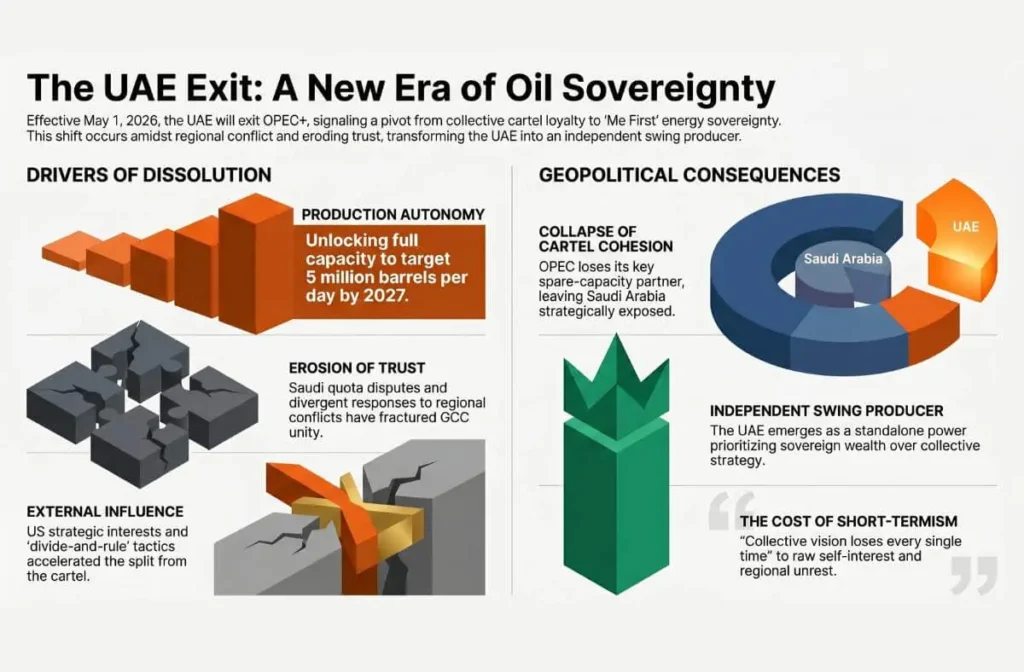
UAE Quits OPEC: Major drivers behind the exit and its far-reaching geopolitical consequences in oil geopolitics.What OPEC Leadership Transformation Looks Like Now
OPEC’s real power always rested on collective credibility and spare capacity.
UAE was one of only two members with meaningful spare capacity. Its exit leaves Saudi Arabia carrying the burden alone.
The cartel just lost roughly 4% of global supply influence and its most reliable partner for managing shocks. Cohesion is fracturing. Other members are already watching closely.
This is OPEC leadership transformation happening in real time — through quiet abandonment rather than any attempt at grand reform.
Leadership Reality Check
The UAE Quits OPEC decision lays bare the current reality of leadership.
- Short-termism in leadership keeps winning because long-term vision has gone missing
- Geopolitical divide and rule exploits every existing crack in unity
- Unchecked domination steadily replaces any shared strategy
- Preparation for wars on multiple fronts now outweighs genuine peace-building efforts
In this environment, today’s geopolitics consistently rewards regional unrest, political tension, and raw self-interest. Collective vision continues to lose ground.
For the UAE right now, the move looks like a clear win.
But the real cost will arrive later — when the next major crisis hits and the old coordination mechanisms that once held things together no longer exist.
The Deeper Crisis We Cannot Ignore
I have spent years living, exploring, and advocating awakened leadership. Moments like this confirm how rare it has become.
Nations now operate like rival corporations in a zero-sum game. They grab immediate advantage and call it strategy. They weaken institutions they may need tomorrow and call it sovereignty.
This awakened leadership crisis runs far beyond oil. We see it in trade, technology, climate, and security. Everywhere, “Me First” thinking spreads.
Powerful players walk away instead of fixing broken systems. Smaller nations pay the heaviest price. Volatility rises. Trust collapses. Future generations inherit fractured alliances and more expensive energy.
“To lead awakened is to strengthen cooperation through reforms, coalesce with courage, and build what lasts for the civilization to believe in.”
— SunDeep Mehra
The Cost That Comes Later
History does not forgive deferred consequences.
OPEC collapse risks grow with every defection. Remaining members face stronger temptation to break ranks. Price swings become sharper. Budgets in oil-dependent countries turn unstable. Investment dries up.
The UAE has positioned itself well for the short term. But when the next regional shock arrives, the absence of coordinated spare capacity will be felt by everyone — including Abu Dhabi.
A Reckoning for All of Us
This single decision forces every leader, government, and society to look inward.
Are we building institutions strong enough to survive the next fracture?
Are we training ourselves to defect the moment it benefits us?
Are we raising leaders who can hold long-term vision under pressure?
The UAE Quits OPEC moment reveals the kind of world we are choosing right now.
Your Voice Matters
I wrote this to spark honest reflection.
Where do you see short-termism in leadership operating in your own country or organization?
Does this UAE move represent smart sovereign strategy or the beginning of wider OPEC collapse in 2026?
What does awakened leadership demand from us in this new reality?
Share your thoughts in the comments. Real progress begins when serious people exchange serious ideas.
The conversation about leadership in our time needs all of us.
Pioneering Awakened Leadership and Governance
Keynote Speaker & Advisor to Governments, Institutions & Global Leaders on AI Ethics, Power & Humanity’s Future