
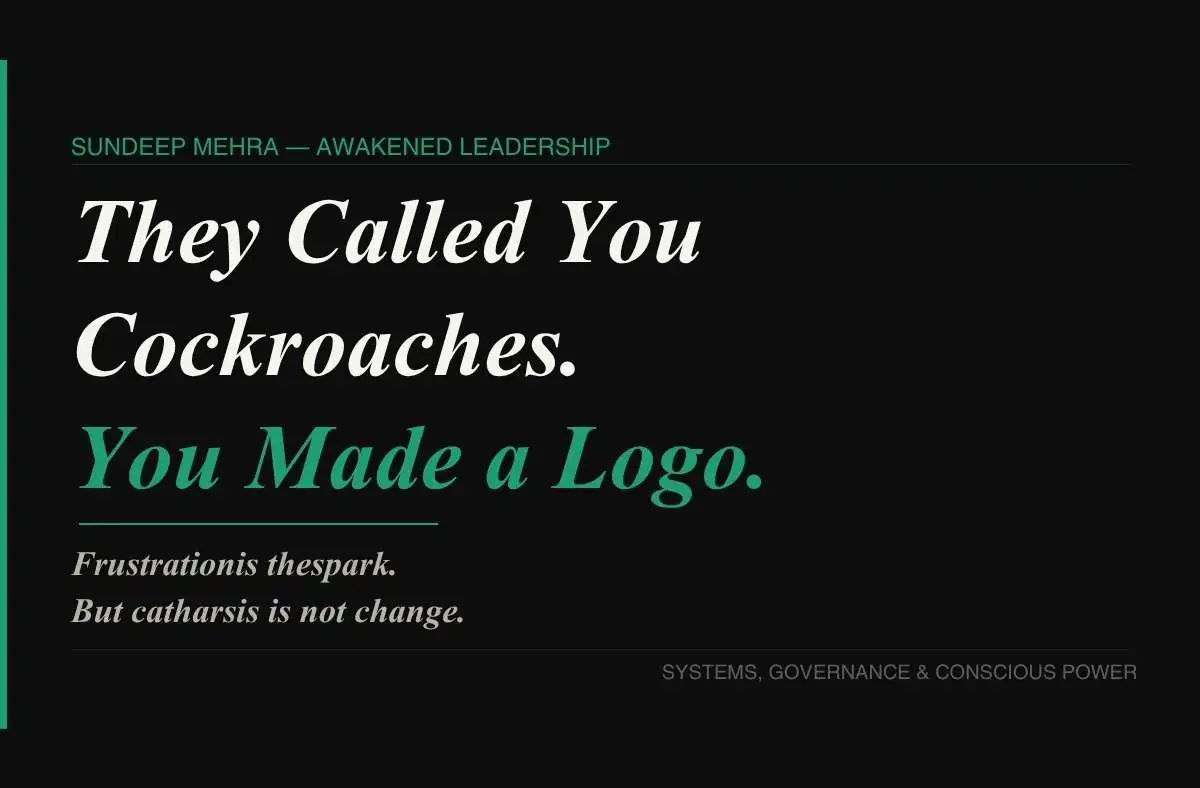
Frustration is the spark. But catharsis is not change.
India’s Gen Z and the nation face genuine leadership, governance, and structural crises — over a third of young graduates unemployed, institutional capture, democratic erosion, a doubtful future, manufactured false claims, and a judiciary that openly sneers at its own citizenry. Justice Kant’s “cockroach” remark wasn’t a slip - it was a window into how the establishment truly perceives dissent. That anger deserves to be taken seriously.
What doesn’t deserve to be taken seriously is the idea that the Cockroach Janta Party — a satirical Instagram account with a Google Form membership — is a response proportionate to that crisis.
1. Viral Movements Without Institutional Memory Die Fast
History is unambiguous on this. India has seen dozens of emotionally-charged, social-media-propelled movements - from Anna Hazare’s anti-corruption wave in 2011 to countless hashtag rebellions - that peaked in weeks and dissolved without a single systemic change. The pattern is consistent: mass emotional participation mistaken for mass political will.
The Cockroach Janta Party crossed 9 million Instagram followers - with just 54 posts - in under five days. That ratio alone tells you everything. In a densely populated country like India, reach without depth is noise. In the Indian political ecosystem - one of the most complex, resource-intensive, and institutionally entrenched in the world - noise does not move structures. It only opens easy pathways for machinations and ruse to settle the storm in no time.
2. Satire Is a Release Valve, Not a Lever
Satire serves a purpose. It names absurdity, punctures authority, and gives the powerless a moment of catharsis. But catharsis and change are categorically different. When satire becomes the primary mode of resistance, it risks functioning as a pressure release - one that actually reduces the likelihood of sustained action by giving people the emotional satisfaction of having “done something” when they have done nothing structurally consequential.
A movement whose eligibility criteria include being “lazy” and “chronically online” is, by its own admission, designed for participation without sacrifice. The manifesto contains genuine political demands. That is not the problem. The problem is that a manifesto without the organizational muscle to enforce it is not politics - it is a wishlist dressed as a platform. No political transformation in history has been achieved on those terms - and every movement that believed otherwise, from the Arab Spring to countless hashtag revolutions, has the wreckage to prove it.
3. Leaderless Movements Are Prey, Not Power
The more urgent danger is this: movements that grow fast without institutional scaffolding don’t remain leaderless. They attract artificial leaders - specifically, the kind of leaders drawn to pre-assembled crowds they didn’t have to build.
Opportunists, ideologues, and power-seekers don’t create movements; they inherit them at peak momentum and redirect them. Anna Hazare’s anti-corruption wave is the cleanest example - Arvind Kejriwal walked into that crowd, institutionalized it into AAP, and redirected it entirely towards electoral power. Dipke himself once volunteered for that very machine.
Abhijeet Dipke is one man, sleep-deprived, running this from Boston. The moment this movement grows beyond his control - and if it continues, it will - the question of who fills that vacuum becomes the only question that matters.
4. Opportunistic Change vs. Systemic Change - They Are Not the Same War
The government’s dysfunction is not accidental. It is the output of decades of institutional decay: captured judiciary, hollowed press freedom, engineered poverty, manufactured religious and communal division, and the systematic defunding of critical thinking in public education. These are not problems that a satirical party can address. Satire did not build these structures. It cannot dismantle them.
Systemic change requires the opposite of what CJP offers - it requires patience over virality, depth over reach, organization over aesthetics, and the willingness to engage in the slow, unglamorous work of institution-building, legal challenge, investigative documentation, and civic education.
The two are not just different strategies. They are different civilizational timescales.
5. What Gen Z in India Actually Needs to Reckon With
The real question isn’t “how do we mock the establishment?” It’s harder than that:
- Why is unemployment structural, not cyclical? Because the Indian economy is increasingly captured by monopolistic conglomerates that consolidate wealth without generating proportionate employment.
- Why does institutional decay accelerate? Because the incentive structures within every pillar - judiciary, media, bureaucracy, academia - now reward loyalty, unjustified reservation, and self-interests, over competence, awakened leadership, and clarity.
- Why does the crowd keep dissipating? Because participation without cost is not commitment - and commitment is the only currency that builds lasting power.
- What does recuperation actually look like? Not a party. A pipeline: legal literacy, investigative journalism, local governance participation, union organizing, and the painstaking construction of trusted civic institutions from the ground up. Every one of those pipeline elements is accessible at the individual level - none requires a party, a logo, or a Google Form.
- Where does the pipeline actually begin? At the top. Civic institutions, legal frameworks, and grassroots movements built from below remain perpetually vulnerable until the leadership above them operates from awakened clarity, purpose, and conscience rather than borrowed power and self-interest. Awakened governance is not idealism — it is the precondition. A pipeline without awakened leadership at its head remains a pipe that leaks.
The burden of building what the previous generation dismantled is unjust. It is also unavoidable.
The movement is not the mistake. The misdirection is. Nine million people who found each other in five days — that kind of force doesn’t come twice. The only question worth asking now is what they aim it at.
Final Word
In a country where a sitting Chief Justice can call its unemployed youth “cockroaches” and walk it back with a clarification, the most radical act is not to embrace the slur with an Instagram filter - it is to build something that outlasts the news cycle and makes that kind of contempt politically costly.
Cockroaches survive. But they do not govern. And survival, at this point in India’s unraveling democracy, is not enough.
Best wishes. Lead Awakened.
SunDeep Mehra
Pioneering Awakened Leadership and Governance