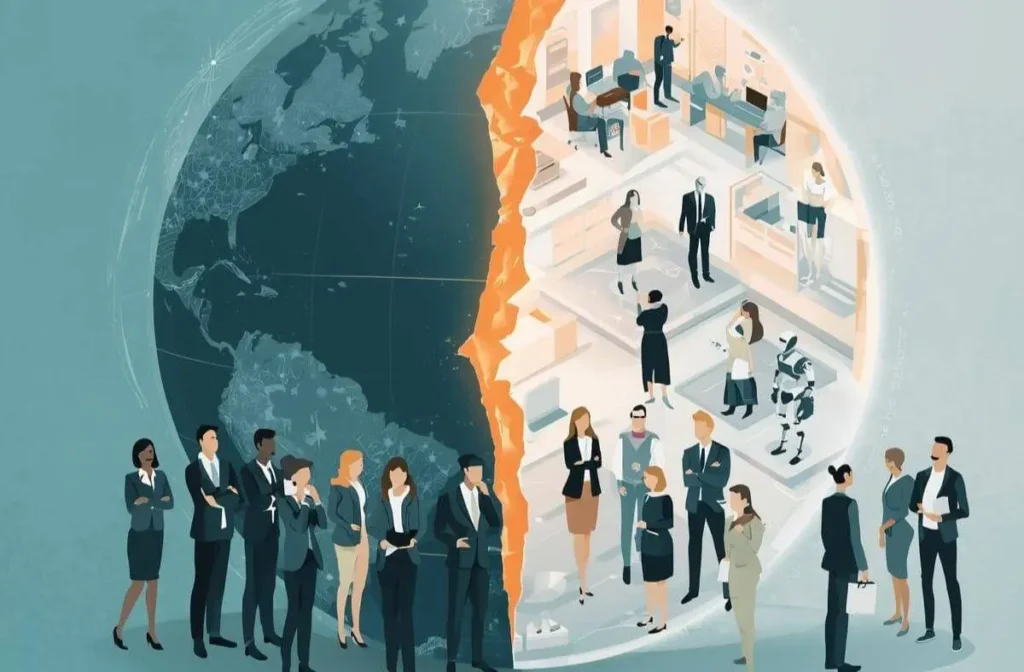
A profound shift is reshaping employment across the planet.
I call it the global employment fracture.
64% of US consumers now expect unemployment to rise over the next 12 months.
This level has doubled since June 2022. It matches the deep concern last seen only during major economic downturns. University of Michigan Surveys of Consumers – January 2026 Report delivers this clear warning.
At the same time, official unemployment figures in many countries remain relatively stable on paper. This widening gap reveals the global employment fracture — a deep structural change in how work is created and sustained worldwide.
Two Parallel Realities
Consumers feel the truth every single day.
They experience hiring freezes. They witness repeated layoffs.
They face recruiter silence and wages that stay flat while corporate profits rise.
These lived experiences shape consumer sentiment jobs across many nations.
Official statistics only capture what governments choose to highlight.
The distance between daily reality and reported numbers keeps growing.
Latest April 2026 Survey Results
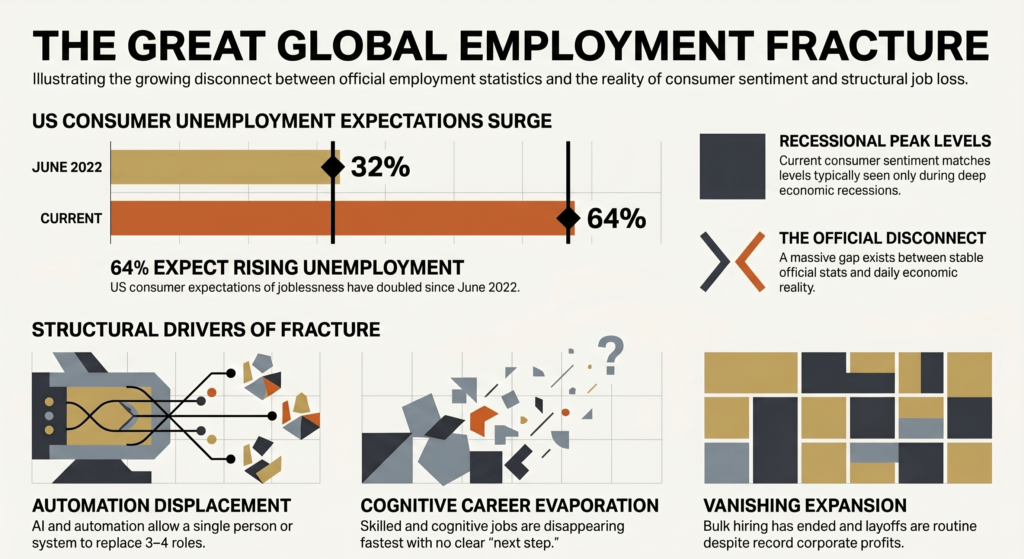
The Global Employment Fracture: 64% of US consumers expect rising unemployment amid AI job displacement and vanishing bulk hiring.Forces Driving the Global Employment Fracture
Several powerful drivers fuel this change:
- AI job displacement accelerates rapidly. Single systems or streamlined teams now handle work once done by multiple people.
- Structural unemployment spreads in skilled and cognitive roles that once formed the backbone of middle-class stability.
- Bulk hiring has largely ended while companies maintain or increase output.
- Layoffs have become standard operating practice in many sectors.
These forces operate together. They move faster than most societies can absorb.
Impact on Societies and Cultures
Work forms the foundation of human dignity and social order.
When steady employment weakens, families tighten budgets and postpone plans.
Communities lose their steady rhythm of contribution.
Cultures that tied identity to productive roles now see younger generations questioning their future place.
Nations built on promises of upward mobility watch those promises quietly weaken.
The global employment fracture tests the basic agreement between people and their institutions. It raises deep questions about human value beyond immediate economic output.
Leadership Accountability Gap
Those holding power face many competing demands.
Election cycles consume attention. Donor events and international conflicts fill calendars and news cycles.
Yet the fundamental duty — preparing economies and people for this massive technological transformation — receives limited serious focus.
This reveals a serious gap in leadership accountability.
Ordinary citizens increasingly appear as costs that can be adjusted rather than people who must be supported.
The largest technological shift since the Industrial Revolution continues while many systems remain stuck in outdated thinking.
When machines do more and more of the work, the real test for leaders is whether they still see people as the purpose — or just as costs to be reduced.
— SunDeep Mehra
The Human Stories Behind the Numbers
Every displaced job carries real weight.
A professional watches years of expertise lose relevance.
A family adjusts after a sudden layoff.
A new graduate steps into markets that reward skills different from what they were taught.
These stories repeat across countries. They build anxiety, erode trust, and reshape hope.
The global employment fracture reaches far beyond economics into the deeper question of what gives life meaning in the coming decades.
Time for Honest Reflection
This moment calls every nation, system, and culture to face difficult questions:
- How do we define valuable contribution when technology handles routine cognitive tasks?
- What new frameworks can support dignity and belonging when economies need fewer workers for the same output?
- How should governments, businesses, and communities together guide this transition?
Answers will not come by avoiding the questions.
From my work as a pioneer of Awakened Leadership and Awakened Governance, and as a leadership keynote speaker and advisor on AI ethics, power, and humanity’s future, I see both the risks and the real possibilities ahead.
The risk is a growing divide between those who control technology and those displaced by it.
The possibility is redesigning education, work, and governance to place human creativity and flourishing at the center.
Moving Toward Real Solutions
Consumer sentiment jobs data provides an early and honest warning.
Leaders across all sectors now face a clear choice.
They can continue with familiar statistics and short-term distractions.
Or they can embrace genuine leadership accountability — honest planning, real investment in people, and courageous adaptation to the new reality.
The second path (Awakened Leadership and Governance) offers the best chance to protect long-term stability and human dignity.
Share Your Perspective
This challenge belongs to all of us.
What changes are you seeing in your own country or industry?
Have you faced frozen hiring, unexpected layoffs, or shifting career paths?
How is the global employment fracture affecting your family, community, or sense of purpose?
Leave your honest thoughts and experiences in the comments below.
Your voice adds crucial reality to this global conversation and helps build the awareness our leaders urgently need.
Let’s make a difference together.
Pioneering Awakened Leadership and Governance