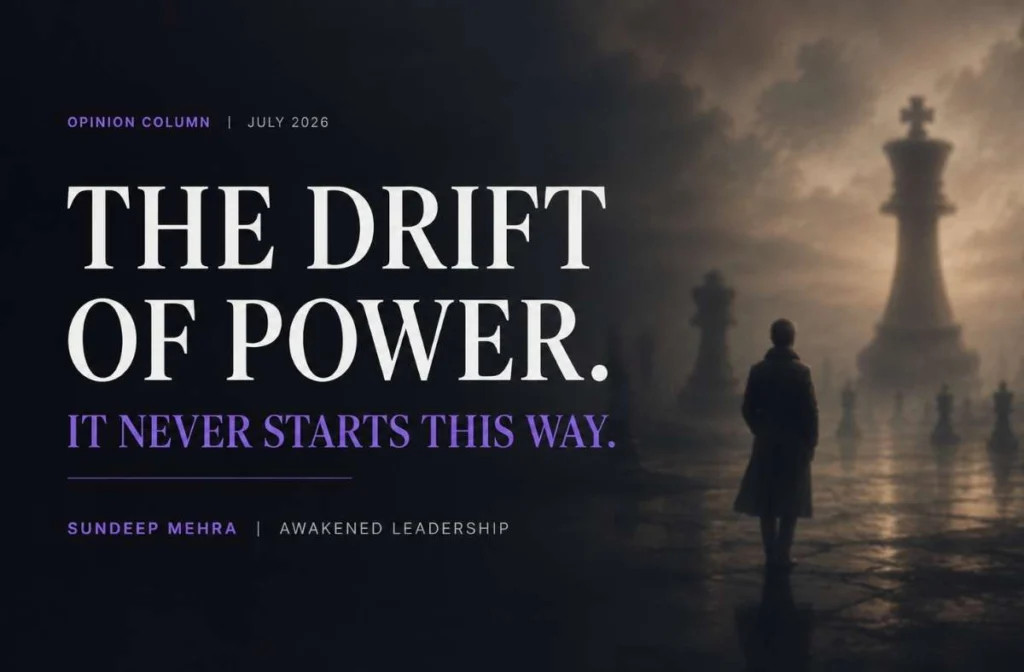
Almost no tyrant sets out to become a tyrant.
That sentence sounds like an excuse. It isn’t one. It is the beginning of an explanation for something that keeps recurring across centuries, ideologies, and continents: a person rises to power promising to heal a real wound, and years later presides over a magnified version of that same wound, handed down to everyone beneath him.
Understanding how that happens matters more than condemning it after the fact.
Evil rarely announces itself as evil. It presents itself as relief. A person who feels powerless is offered control. A person aching for significance is offered a cause. A person exhausted by chaos is offered order. These desires carry no shame in themselves. Powerlessness is a real condition. Chaos is a real threat. The offer succeeds because it takes aim at something true, and what a person surrenders in accepting a shortcut to it rarely announces itself until much later, when the cost has already compounded.
The pattern tends to follow a recognizable course. A real wound comes first, some humiliation, some collapse into disorder, some threat vivid enough to make the hunger for control feel justified. An early taste of power follows, and it works. A problem resolves. Order returns. At this stage the exercise of authority often remains legitimate, even necessary, which is precisely what makes the next step so difficult to detect.
Control begins, almost without anyone noticing, to outgrow its original purpose. What started as a tool for restoring safety or order slides quietly into becoming the object of desire in its own right, the way any relief from pain gradually turns into its own appetite. No single decision marks this transition. It accumulates.
From there the reasoning hardens into something defensive. A threat to the leader’s control gets folded into the language of the cause itself, so that disagreement no longer registers as mere friction but as sabotage of the people, the revolution, the nation, the mission. The leader loses the capacity to distinguish between defending his power and defending his purpose, because in his own mind the two have fused into a single object.
What follows is the step history remembers most clearly. The leader produces, with method and scale, precisely what he once rose to prevent. A man who came to shield people from fear becomes its source. A voice raised for the powerless becomes the presence no one dares speak freely in front of. A builder ends his career presiding chiefly over ruin, because the maintenance of control now consumes more energy than any act of creation ever could.
History offers this arc again and again, across ideologies that otherwise share almost nothing. Robespierre helped topple a monarchy accused of arbitrary terror and went on to preside over a terror of his own design.
Stalin, who cast himself as guarantor of the revolution’s survival, consumed the party and the peasantry the revolution claimed to serve. Mao’s promise to remake society into something more just produced famine and purges that dwarfed the injustices they replaced. The ideology changes with each case. The underlying architecture, a real wound answered by control, control quietly displacing purpose, purpose hardening into self-justification, self-justification collapsing into inversion, recurs with unsettling fidelity.
What makes this hardest to see from within is that the person living through it rarely experiences himself as having changed sides. Every escalation feels continuous with the original mission, and several forces conspire to preserve that impression. Power thins out the ranks of people willing to speak the truth, since honesty begins to carry real cost long before dishonesty does.
The leader’s identity fuses with the cause until criticism of one reads as an assault on the other. And the very machinery used to secure control, surveillance, suppression, propaganda, manufactures the enemies it was built to guard against, which then appears to confirm the original fear rather than expose its origin. Layered beneath all of this sits the gravitational pull of accumulated damage: admitting the mission has been betrayed would mean admitting the damage was for nothing, so the logic keeps moving forward rather than turning to face itself.
The deeper cost lands on the society built beneath such a leader, and it rarely arrives as violence alone. It arrives as a slow atrophy of collective capacity. Truth stops circulating freely once the wrong word at the wrong moment carries a price, and without it the leader loses the information required to govern well while the public loses the means to correct course. Initiative withers alongside it, since the safest posture under surveillance is to attempt nothing and resemble everyone else, and a society organized around resemblance forfeits its ability to solve its own problems.
Worst of all, the original wound reproduces itself a generation later: a population governed by a leader who rose from powerlessness and came to rule through fear tends to end up more powerless than it began, now carrying trauma as well, which leaves it more vulnerable, not less, to the next tailored promise that arrives in the same shape.
None of this requires evil to look like evil. It requires only that it resemble relief, offered to someone genuinely in pain, through a channel that will eventually extract more than it gives.
One question cuts through most of the disguise. Ask it of a leader, or of yourself: does getting what I want here require that I stop being correctable? The instant power, ideology, or cause demands the silencing of anyone who might say you have drifted, the drift has already begun, regardless of how just the original aim was, and regardless of how sincerely it is still invoked.