We are walking blindfolded into a historic financial trap. The world is accelerating toward a devastating global debt crisis.
The numbers demand our immediate attention. Our collective future is at stake. I look at the recent data, and the reality is deeply sobering.
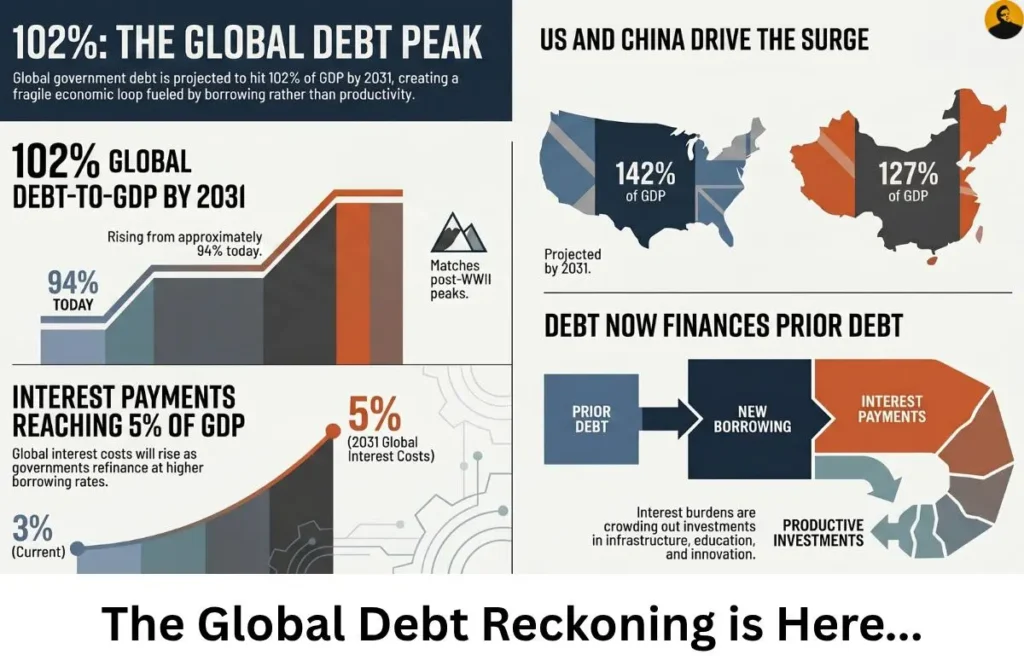
The International Monetary Fund (IMF) has released its latest Fiscal Monitor April 2026. General government gross debt stood at just under 94% of GDP in 2025 and is projected to reach 100% by 2029 — a full year earlier than previous forecasts. By 2031, the global debt-to-GDP ratio is on track to hit approximately 102%. We have not seen sovereign debt levels like this since the aftermath of World War II.
Back then, humanity had decades of high economic growth ahead. We could outgrow the massive debt burdens. Today, that luxury is completely gone.
Productivity growth has stagnated in many major economies. We lack the organic growth needed to offset these looming liabilities.
The Drivers of Our Fragile System
Who is driving this massive global surge? The United States and China account for the vast majority of the increase. Since 2015, debt-to-GDP has risen by 16 percentage points globally.
The US is running persistent government deficits of 7–8% of GDP. There is no credible consolidation plan in sight. By 2031, US debt is on track to reach 142% of GDP.
China is following a similarly dangerous path. To support domestic demand, their deficit is nearing 8%. China’s broader public debt measures are projected to rise toward 127% by 2031.
These two nations set the global benchmarks. They are the largest economies with the deepest capital markets.
Borrowing costs are changing dramatically. Governments must now refinance maturing debt at much higher rates. This creates a severe duration problem. Elevated costs get locked in automatically — even if nations stop borrowing new money completely.
Global interest payments are expected to surge dramatically. They will rise from roughly 3% of global GDP today toward about 5% by 2031.
Our global economy is increasingly fueled by debt. We are no longer fueled by genuine productivity or people-centered innovation.
The Collapse of Long-Term Stewardship
Why are our nations and systems failing to deliver real prosperity? The blame does not lie with a single leader, party, or nation. The responsibility is entirely systemic.
We have political systems optimized for short-term popularity. Electoral cycles heavily reward immediate spending. Politicians focus blindly on entitlements, defense, and subsidies.
These systems deliberately defer the true costs to future generations. Fiscal discipline is seen as politically toxic.
Central banks have consistently enabled this dangerous behavior. Decades of low or negative real rates encouraged reckless borrowing. Central banks became de-facto backstops. This created massive moral hazard across the entire financial system.
Global governance gaps leave us with no effective supranational fiscal rules. National sovereignty and veto power always prevail.
Corporate and elite interests greatly benefit from cheap capital. They thrive relentlessly on debt-fueled asset inflation.
Meanwhile, citizens often accept empty political slogans. They shy away from facing hard arithmetic trade-offs. Power essentially serves itself when accountability is diffuse.
“We cannot build a prosperous civilization on a foundation of deferred costs. Awakened stewardship demands we face the arithmetic of our actions today, before the math makes our choices for us.”
Debt now finances the interest on prior debt in many cases. This self-reinforcing loop is incredibly destructive.
It crowds out critically important productive spending. We are losing vital investments and reforms in education, infrastructure, human first R&D, and climate resilience.
This is a massive intergenerational wealth transfer. We are stealing from future generations to pay today’s bondholders and politicians.
The Looming Civilizational Risks
The medium-term outlook is intensely grim. Between 2029 and 2035, extreme global debt becomes the new normal. We will likely see severe financial repression.
Advanced economies may resort to negative real rates, inflation taxes, or capital controls. Inequality will widen significantly. Social cohesion will fray beyond repair.
We risk severe social fragmentation and the total erosion of public trust. Rising discontent over the cost of living could easily trigger authoritarian or populist turns.
Vulnerable emerging markets face imminent crises. They will likely suffer defaults or require IMF bailouts tied to strict, painful austerity.
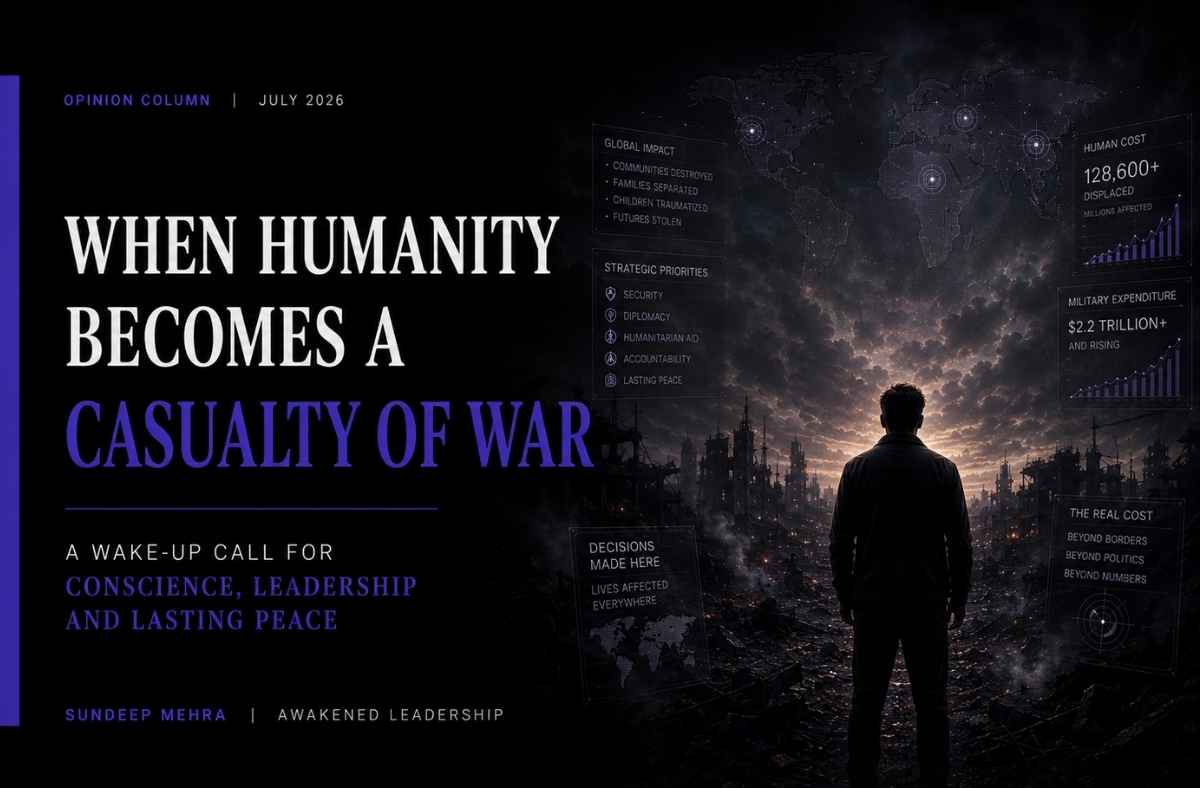
The geopolitical landscape makes everything much worse. Wars and conflicts directly accelerate debt accumulation. The IMF explicitly notes conflicts in the Middle East as a debt accelerator.
Defense build-ups and protectionism increase spending while fragmenting economic growth. Sovereign balance sheets remain structurally fragile.
A sudden shock could trigger forced austerity, capital flight, or rapid repricing. Energy spikes, wars, or AI disruptions could easily serve as the catalyst.
The IMF warns that severe cases could push debt-at-risk beyond 117% of GDP. We could see debt weaponized regionally. We might face a fragmented global reset via default or extreme inflation.
The Path of Awakened Leadership
Without a serious course correction, prosperity erodes entirely. We will face severe stagnation or extreme volatility. But a window for meaningful change remains open.
I have always advocated Awakened Leadership as a powerful, necessary solution.
This approach calls for a fundamental shift in how we lead, govern, and make decisions.
Awakened leadership is pragmatic, ethical, and entirely rooted in truth-seeking. It requires deep wisdom, morality, compassion, and extreme courage.
We must abandon zero-sum, tribal thinking completely. We must reject the idea of power-amok self-service in our institutions.
To build a resilient future, our systems must embrace core systemic shifts:
- Long-Term Stewardship: We need fiscal rules with actual teeth and independent oversight.
- Humanity-First Governance: We must aggressively prioritize education, health, and dignified work over extraction and weapons.
- Diplomacy Over Domination: Nations must prioritize collaborative problem-solving on trade, climate, and AI ethics.
This critical shift affects every single level of society. Nations must fundamentally restore credibility to lower borrowing costs.
Businesses must focus on long-term value creation. They must make real investments that lift everyone.
Education must urgently teach critical economic literacy, morality, and ethics. Technology must serve human flourishing, rather than driving surveillance or jobless inequality.
Individuals must deeply empower themselves. We must build personal and familial resilience. We need to develop hard skills and build savings outside of traditional fiat systems.
We must foster parallel resilient systems and local economies. We need to step completely away from absolute dependency. A genuinely awakened world heals divides through compassionate and Awakened Governance.
Hard Questions for a New Era
We must ask ourselves highly critical, uncomfortable questions:
- What exact legacy are we leaving our children and grandchildren?
- Is our current policy sustainable for 50 years, or just the next election cycle?
- Who truly benefits from our economic systems — elites or the broader population?
- Are we investing in human potential, or merely managing our own civilizational decline?
- Where is the courage to make highly unpopular but entirely necessary trade-offs?
- How do we measure true success? We must look far beyond basic GDP numbers. We must focus intently on human dignity, social cohesion, and planetary health.
The data is incredibly clear. The sheer arithmetic cannot be ignored. Our civilization faces a stark, binary choice.
We can continue comfortably with debt-fueled illusions. Or we can consciously choose awakened stewardship. I believe humanity deeply deserves the latter.
The future of work, leadership, governance, and civilization hinges entirely on this choice. The path forward requires collective clarity, compassion, and fierce resolve. The time for empty political slogans has definitively passed.
Pioneering Awakened Leadership and Governance
Join the Conversation
How do you view the current trajectory of our global economy? What specific steps do you think our local communities and global leaders should take to build real resilience in the face of these systemic failures?
Please share your deepest thoughts, inputs, and strategies in the comments section below.