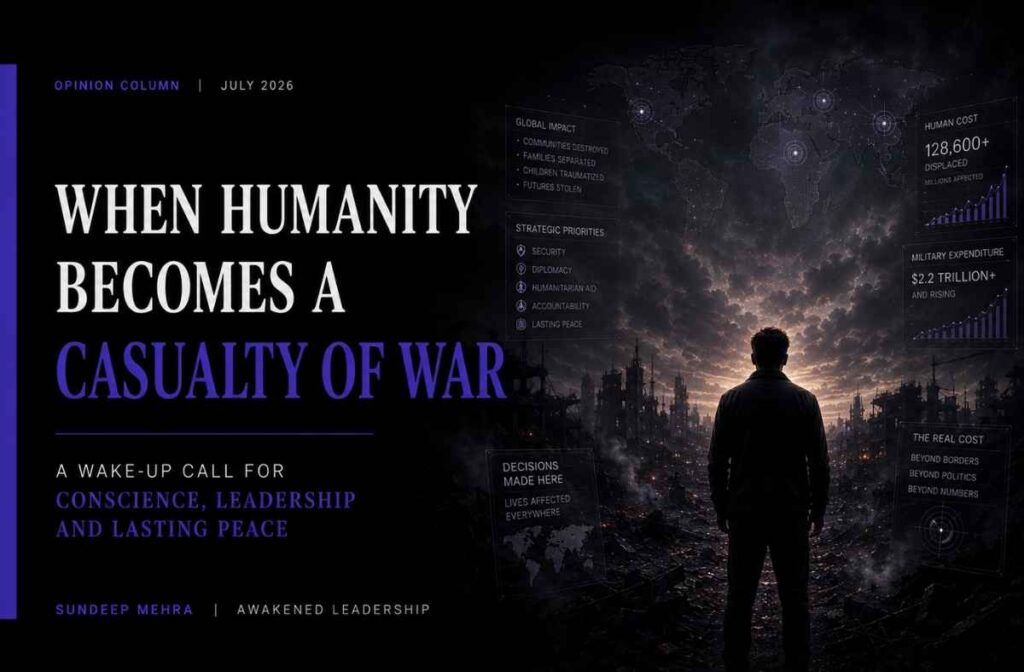
You cannot know the true price of war until someone you love stands where death has become a possibility. Until then, war stays a headline, a map, a debate, something happening to other people.
Right now it has faces. A mother in Kharkiv checks her phone at 3 a.m. because the sirens have started again, a father in Gaza is digging through concrete with his bare hands because the machinery can’t get there fast enough, and somewhere in Tehran a family keeps glancing at a sky that was empty a year ago. None of them asked for any of this. Their children will be carrying it long after the news cycle has moved on to something else.
Distance protects more than our bodies. It protects our conscience, too. It’s a lot easier to hold an opinion about a war than to actually live under a bomb shelter. Easier to argue about a border on a map when your own street isn’t the one being redrawn.
Every war shows up with its own explanation. History gets invoked, then security, then sovereignty, then deterrence, and the words shift depending on which capital happens to be speaking that week. Everybody involved sounds certain they’re the reasonable one, which is exactly the problem, because the family burying a son or daughter was never consulted about whose reasoning made more sense.
This piece isn’t trying to rank whose case is stronger. That argument has already filled every newsroom and parliament for decades, and it rarely changes anything for a family standing at a fresh grave. What’s worth noticing instead is something these wars have in common: the people making the decisions have never had to live where those decisions land.
The men ordering the strikes don’t sleep in the buildings that get hit, and the men signing off on invasions don’t send their own sons to the front line. Somewhere along the way, leadership turned into a job you can do from a safe distance, and a decision made from safety always costs the decision-maker less than it costs everyone downstream of it.
That gap, between the ones who decide and the ones who bleed, is where conscience goes quiet. Nobody wakes up one morning and chooses cruelty outright. It creeps in through smaller habits: calling people strategic assets, calling their deaths collateral damage, calling their suffering an acceptable cost. Say it enough times and the words stop sounding harsh. Once people turn into numbers, conscience gets a lot more flexible.
No country gets to call itself advanced while it grows comfortable describing another people’s suffering as a line item in a strategy memo. A stronger military doesn’t make a country more moral. You can win every calculation on paper and still walk away having lost the one thing that made winning matter.
Indifference doesn’t take any courage, whatever people tell themselves. Real courage is harder than picking a side and defending it louder than the evidence deserves. It means recognising someone else’s grief before checking their passport, their religion, their language, or the flag they happened to be born under. Grief has never once checked anyone’s papers before it arrived.
This is what makes leadership and governance fragile once those who exercise power stop sharing the risks they create. People who send others to war rarely pay for it themselves. Someone who had actually buried a relative at a checkpoint, or waited by a phone that never rang again, would think twice before reaching for escalation. None of this argues against defending a country from real threats, from terrorism, from people who genuinely mean harm. Every nation has a right to protect its own people. Protection and domination just aren’t the same instinct, even when domination keeps borrowing protection’s language to sound respectable.
Leaders aren’t going to wake up to this on their own, so waiting for them isn’t a plan. Every generation gets roughly the leadership its own moral condition allows to rise. When a society stays quiet, that silence doesn’t stay neutral for long. It turns into permission, and it’s the quiet public that gives cover to leaders willing to spend other people’s children on a headline about strength. Until we build a different leadership model, we should not expect different outcomes.
Peace was never something you get by signing a piece of paper after enough blood has already soaked into the ground. It survives only where ordinary people decide, on their own, that a stranger’s loss weighs just as much as their own would.
Get enough people to actually believe that, and you’ll have found the only kind of deterrence that has ever ended a war for good instead of just postponing the next one.