
Every institution carries a responsibility that extends beyond the authority it exercises. Courts uphold justice. Legislatures make laws. Governments administer the state. Universities preserve knowledge. The media performs a different function altogether. It shapes the public understanding through which every other institution is ultimately judged. When that responsibility begins to weaken, the consequences spread quietly across the entire democratic system because citizens can only make informed democratic choices when the information before them deserves their confidence.
India’s media stands at such a moment.
This is neither a partisan accusation nor a nostalgic longing for an imagined golden age of journalism. Every democracy periodically questions the performance of its press. Britain has done so. The United States continues to do so. France, Germany, Australia and many other democracies wrestle with similar concerns. The challenge confronting India therefore belongs to a much larger global story about what happens when commercial incentives, political polarisation and technological disruption begin reshaping the institutions responsible for informing the public.
The issue is not that journalists make mistakes. They always have. Responsible journalism has never depended upon perfection. Its credibility has rested upon an enduring commitment to curiosity, verification, proportionality and the willingness to correct itself when it falls short. Democracies extend remarkable freedoms to the press because those freedoms exist in service of the public rather than the profession itself. Freedom without public purpose eventually becomes another form of institutional self-preservation.
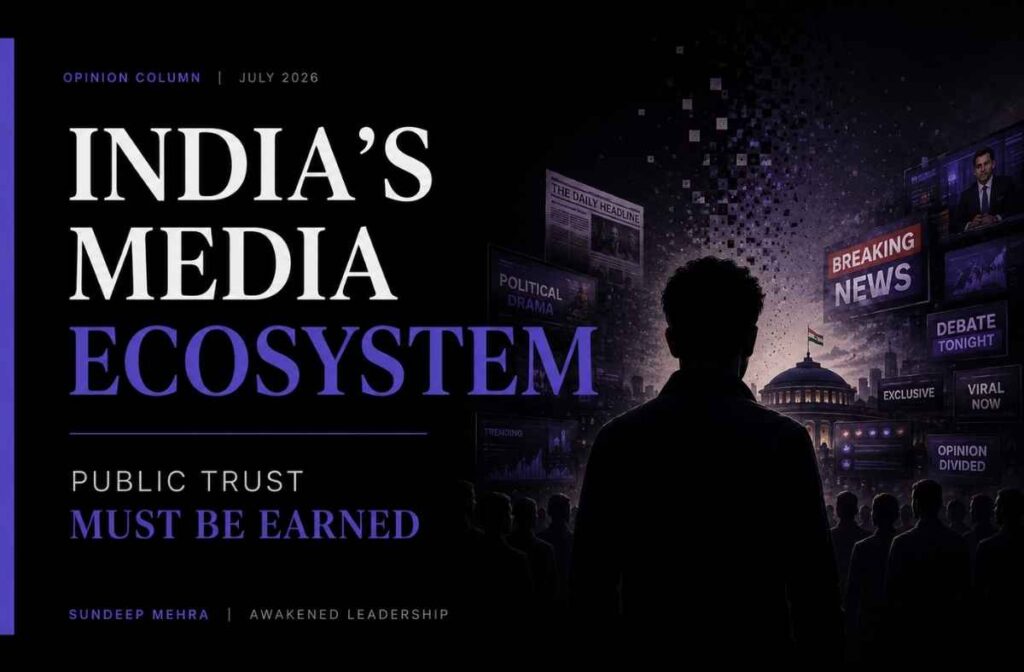
Over the past decade, a subtle but consequential shift has occurred within significant parts of India’s media ecosystem. Large sections of public discourse increasingly revolve around personalities rather than public questions, conflict rather than consequence, spectacle rather than scrutiny. News cycles accelerate. Outrage becomes commercially valuable. Television debates reward confrontation because confrontation retains attention. Digital algorithms reinforce certainty because certainty generates engagement. The economics of attention begin shaping editorial judgement with a force that few traditional newsrooms anticipated.
None of this is uniquely Indian. It reflects pressures affecting media organisations throughout the democratic world. Yet India’s scale amplifies both the opportunity and the risk. Hundreds of millions of citizens increasingly encounter public affairs through fragmented digital ecosystems where journalism competes with influencers, political messaging, artificial intelligence, anonymous accounts and algorithmically amplified opinion. In such an environment, credibility becomes the media’s most valuable asset. Once that credibility begins to erode, audience size alone offers little protection.
This helps explain why moments involving independent public voices have acquired significance beyond their immediate circumstances. Whether one considers the public discussions surrounding Abhijeet Dipke or the civic campaigns associated with Sonam Wangchuk, the larger democratic lesson remains remarkably consistent. Citizens were not merely responding to individuals. They were responding to an absence they believed had emerged elsewhere. Whenever substantial numbers of people begin turning towards independent voices in search of clarity, journalism should ask itself a difficult question before asking difficult questions of everyone else. What need are citizens attempting to satisfy outside the institutions specifically created to inform them?
That question deserves honest reflection because public confidence rarely disappears without reason. Trust migrates. It follows those whom citizens believe are listening carefully, asking necessary questions and demonstrating intellectual independence. It is entirely possible for an individual operating with modest resources to command greater public confidence than an institution employing thousands of professionals. When that happens repeatedly, the issue is unlikely to be the individual’s popularity alone. It may instead reveal an institutional relationship with the public that has gradually weakened.
The consequences extend well beyond journalism itself. Democracies rely upon informed citizens capable of distinguishing evidence from emotion, governance from performance and accountability from accusation. When media institutions increasingly reward immediacy over investigation, volume over depth and confrontation over understanding, they unintentionally narrow the public space in which democratic reasoning takes place. Citizens eventually begin constructing alternative information networks, independent newsletters, local platforms, long-form conversations, community media and direct public engagement with individuals they perceive as more trustworthy. Technology enables that migration with unprecedented ease.
The emergence of issue-driven political formations across India should be understood within this broader institutional context. These movements are frequently interpreted as electoral experiments or tactical responses to established political parties. They also reveal something more fundamental. Citizens increasingly organise around specific public concerns because they are searching for institutions that remain visibly connected to lived experience. Environmental protection, urban governance, public services, local accountability, agriculture, judicial efficiency and regional identity have become organising principles because they speak directly to everyday realities. The rise of such movements is less a rejection of democracy than an attempt to restore responsiveness where many perceive institutional distance.
Journalism should have recognised this transformation earlier.
Instead, much of the national conversation has often remained absorbed by the daily choreography of political competition while deeper structural changes unfolded beneath the surface. Elections received minute-by-minute analysis. Parliamentary exchanges dominated headlines. Political personalities occupied endless hours of airtime. Meanwhile, the quieter story unfolding across Indian society received comparatively less sustained attention: citizens were gradually redefining whom they trusted, how they participated and where they sought public credibility.
That may prove to be one of the defining institutional stories of contemporary India.
An apology, therefore, should not be understood as an admission of malicious intent. Democracies are strengthened when institutions possess the confidence to acknowledge where they have fallen short. The most respected newspapers and broadcasters in democratic history have preserved their authority precisely because they recognised that credibility grows through accountability rather than defensiveness. Institutions capable of self-correction become stronger after criticism. Institutions incapable of reflection eventually become subjects of the very scrutiny they once directed towards others.
The Indian media owes the nation an apology because it has too often underestimated the intelligence of its audience. It has too often mistaken political theatre for public importance, confused constant visibility with genuine relevance and allowed the urgency of daily confrontation to overshadow the slower, more demanding work of explaining how institutions shape the lives of ordinary citizens. The apology is owed not because every journalist failed, nor because every newsroom abandoned its responsibilities. Many continue to produce courageous, rigorous and deeply important work under increasingly difficult conditions. It is owed because, as an institution, the media has not consistently met the democratic expectations placed upon it by the society whose confidence it depends upon.
India remains one of the world’s most consequential democracies. Its future will not be determined solely by governments, elections or political parties. It will also depend upon whether the institutions responsible for informing public life possess the humility to renew themselves before citizens complete the search for credibility elsewhere.
That challenge belongs to journalism everywhere.
The question confronting India today will confront every democratic society tomorrow. In an age defined by artificial intelligence, fragmented information ecosystems and declining institutional loyalty, journalism can no longer rely upon its historic position. It must continually demonstrate why it deserves public confidence. The future of democratic media will not be secured through louder voices, faster headlines or greater ideological certainty. It will be secured through the patient recovery of the one resource every institution ultimately depends upon and none can demand by right: public trust.