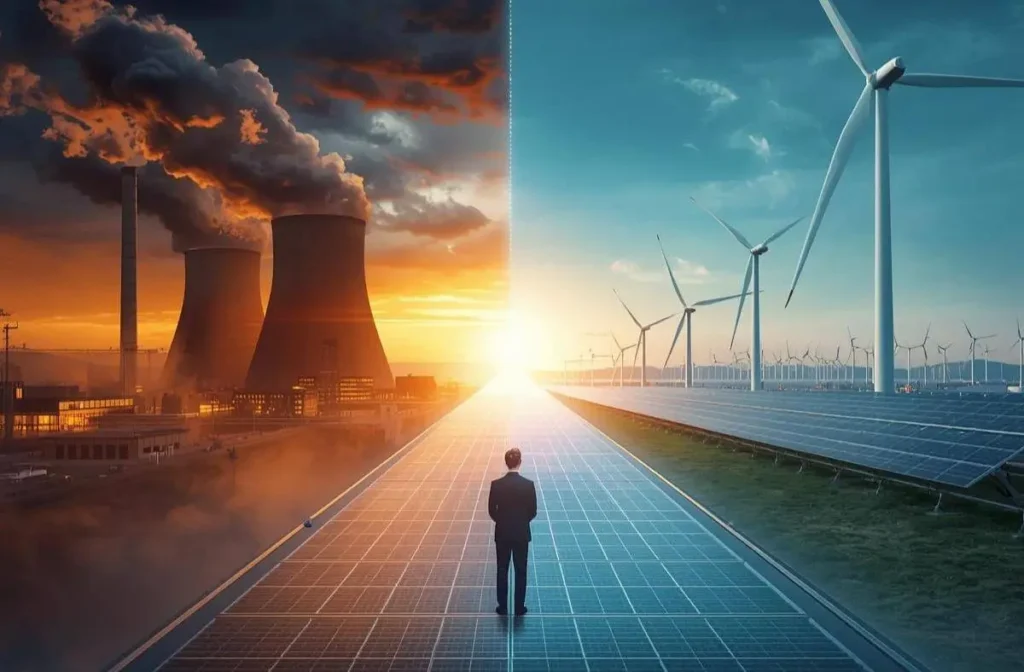
The world stands at a pivotal moment in the global energy transition.
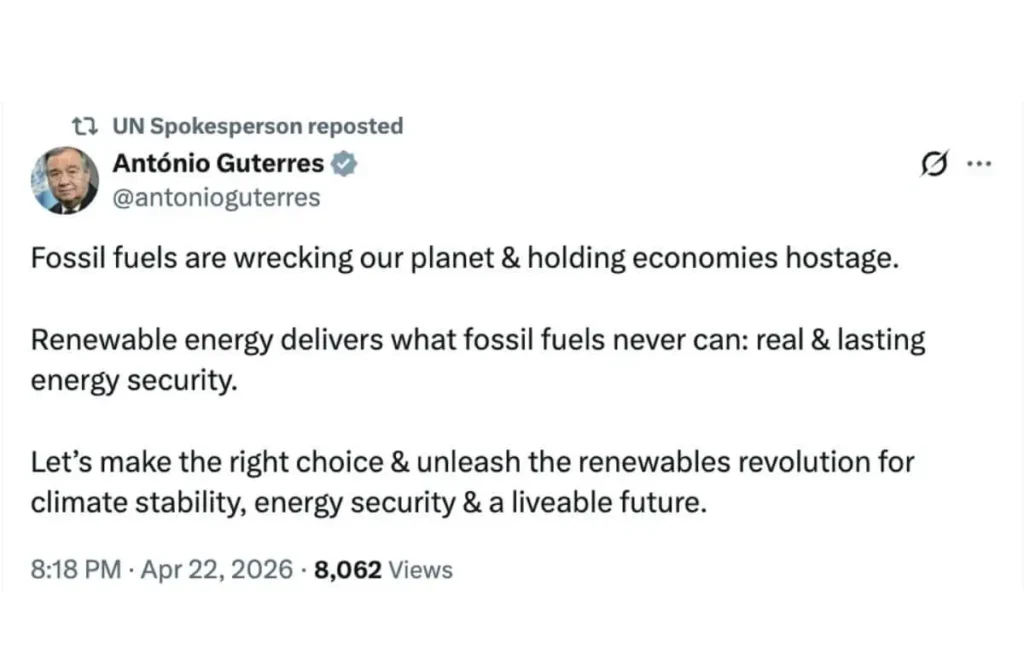
On April 22, 2026, UN Secretary-General António Guterres posted a clear message on X:
That same year, the Trump administration pushed hard in the opposite direction.
These tensions reveal deep truths about our world.
The UN Vision for Renewables Revolution
Guterres has consistently championed the renewables revolution. He points to record clean-energy investments reaching $2.2 trillion in 2025 — twice the amount invested in oil, natural gas, and coal, according to the IEA’s World Energy Investment 2025 report.
For global institutions, the path is clear. Move fast. Break free from fossil dependence. Build a livable future through clean power.
This view shapes international climate talks. It frames the global energy transition as urgent and unified.
America’s Focus on Coal Resurgence
The Trump administration chose a different route.
In April 2025, President Trump signed an Executive Order titled “Reinvigorating America’s Beautiful Clean Coal Industry.” It declared coal essential for national and economic security.
The order removed regulatory barriers. It sped up federal land leases. It supported coal-fired power for manufacturing and AI data centers.
By 2025, US coal resurgence delivered the world’s largest single-nation increase — +37 million tonnes, according to the IEA Coal 2025 report. Emergency orders from the Department of Energy kept retiring plants running to avoid blackouts, as detailed on the DOE’s 2025 Section 202(c) Orders page.
For the United States, energy security priorities come first — reliable, affordable power that supports jobs and industrial strength.
China’s Powerful Dual Approach
China leads the renewables revolution in scale. In 2025 it added hundreds of gigawatts of solar and wind — far more than any other country, according to the IEA Global Energy Review 2026.
Yet China also consumed 4,953 million tonnes of coal — the world’s largest share — with coal providing backup for variable renewables and powering heavy industry, according to the IEA Coal 2025 report.
This dual strategy influences the entire global energy transition. It shows that even the biggest renewable player still needs reliable baseload power.
What 2025 Data Actually Reveals
The International Energy Agency’s Coal 2025 report gives clear numbers:
- Global coal demand reached 8,845 million tonnes — a slight rise.
- United States led absolute growth through coal resurgence.
- China held steady at massive scale.
- Renewables grew strongly but could not yet replace all dispatchable power.
The global energy transition is real. It is also uneven, complex, and shaped by hard engineering and economic realities.
Why the Climate Policy Divide Persists
Nations face different pressures:
- Advanced economies focus on decarbonization.
- Emerging nations prioritize lifting people out of energy poverty.
- Grid stability concerns clash with rapid phase-out targets.
- Short political cycles fight against long infrastructure lifespans.
This climate policy divide is not simple misunderstanding. It reflects real differences in sovereignty, development needs, and security concerns.
Governments balance immediate jobs against long-term climate risks. Societies demand both affordable electricity and environmental protection. Cultures shaped by energy abundance now question future sacrifices.
A Moment for Deeper Reflection
The global energy transition tests far more than technology. It tests who we truly are — as nations, as leaders, and as societies.
“Our choices in the global energy transition reveal our true character. The energy path we choose shows the depth of our foresight, the strength of our responsibility, and how sincerely we care about the future we leave for coming generations.”
— SunDeep Mehra
This quote captures the stakes. Our energy choices expose who we truly are as societies, nations, and leaders.
Why Awakened Leadership Remains Missing
Awakened Leadership integrates full reality — climate science, engineering limits, economic trade-offs, and human development needs.It refuses to deny measurable warming.
It also refuses to ignore intermittency, scale challenges, and energy poverty.
Current systems often prioritize ideology or short-term politics. Global institutions push unified targets. National governments protect sovereignty and prosperity. Both approaches contain truth. Both remain incomplete.
Awakened leadership would bridge this gap through:
- Innovation across all low-carbon options — nuclear, geothermal, storage, and advanced coal with controls.
- Grid modernization and critical mineral investment.
- Technology transfer that respects national realities.
- Outcome-focused metrics instead of fuel-type quotas.
Without awakened leadership, the climate policy divide deepens. Progress slows. Trust erodes.
The Realistic Path Forward
The global energy transition succeeds when it embraces pragmatism.
Deploy renewables where they deliver strongest value. Maintain reliable sources where needed. Accelerate breakthroughs in every clean technology.
Measure success by results — affordable access, falling emissions intensity, resilient economies.
2025 already showed historic renewable growth alongside plateauing coal demand. The transition moves forward, but on its own uneven timeline.
A Call to Societies, Cultures, and Leaders
Nations, governments, and cultures must now choose.
Will we cling to polarized positions? Or will we demand awakened leadership that serves all of humanity?
The global energy transition will shape the 21st century. Coal resurgence, renewables revolution, and energy security priorities will remain central to the debate.
Our response today determines the world our children inherit.
What are your thoughts?
Share your views in the comments below. How can we build awakened leadership and governance in the global energy transition? Your perspective matters. Let’s build a wiser conversation together.
Pioneering Awakened Leadership and Governance
Keynote Speaker & Advisor to Governments, Institutions & Global Leaders on AI Ethics, Power & Humanity’s Future