

Version 1.0, November 2025
Introducing Awakened Clean Air Covenant for Delhi and Delhi NCR
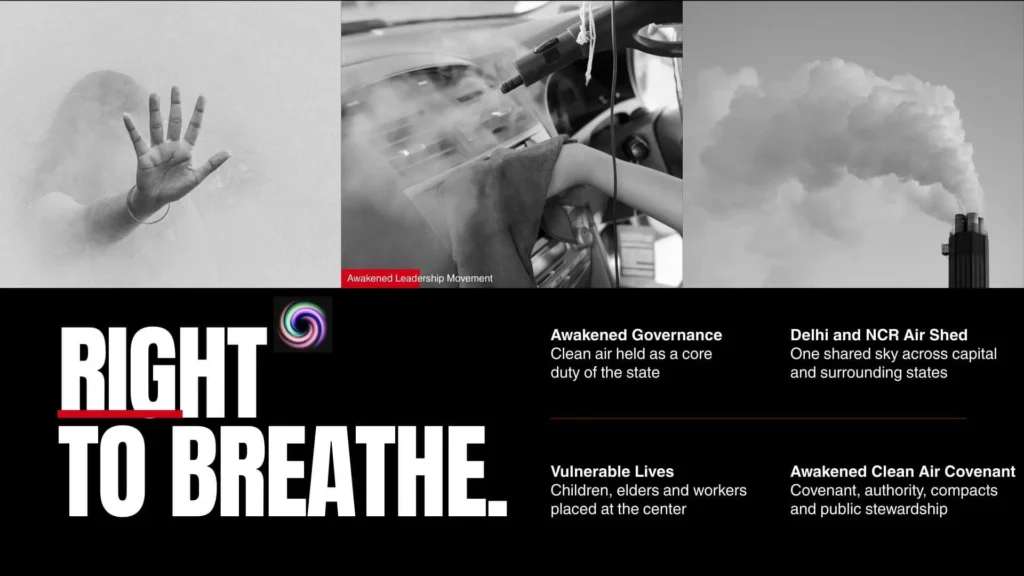
Delhi and the wider NCR region live with a recurring air emergency each year. Children, elders and workers inhale air that damages health, weakens trust in governance and quietly reshapes daily life around survival.
This article presents the Awakened Clean Air Covenant for Delhi and Delhi NCR, first released as an Awakened Leadership Compass Brief (Version 1.0). It is grounded in Awakened Leadership and Awakened Governance, and offered by the Awakened Leadership Movement as a self led and selfless contribution to governments, institutions, experts and citizens who seek a clear, life centered pathway for Delhi and the NCR air shed.
What follows is the full text of the Awakened Clean Air Covenant and Governance Model for Delhi and Delhi NCR, shared in blog form so it can be read, searched, cited and discussed more easily while remaining faithful to the original Version 1.0 white paper.
1. Preamble
Delhi’s air asks a simple question to every leader, institution and citizen: What is the value of development if a child’s next breath is unsafe?
This model presents a complete, humane and systemically grounded pathway for transforming Delhi and the wider NCR region from a recurring air emergency into a region that treats breathable air as a sacred civic minimum.
Awakened Leadership starts from one core recognition. Governance is not a machinery for managing crises. Governance is a living responsibility to protect the essence of life in every policy, budget and decision. Air belongs in that innermost circle of responsibility.
The Awakened Clean Air Covenant and Governance Model for Delhi and Delhi NCR, Version 1.0 is offered as a ready to adopt, ready to adapt framework. It is written to be directly usable by ministries, departments, regulators, city governments, courts, civil society and citizens who seek clarity, coherence and courage.
This is a living model. It invites implementation, learning and refinement, guided by one unshakable standard:
No interest is allowed to stand above the right to breathe.
2. Vision and Purpose
Vision
Delhi and the wider NCR region become a place where clean, breathable air is a guaranteed and experienced reality across all seasons, upheld as a core expression of human dignity, health and intergenerational responsibility.
Purpose
- Align constitutional duty, political will, institutional capacity and citizen action around a single, measurable clean air outcome.
- Transform Delhi’s air governance from seasonal firefighting into an integrated, year-round system of prevention, protection and regeneration.
- Place the most vulnerable first in design, funding and enforcement.
- Embed a new culture of leadership where truth, conscience and awakened clarity guide environmental decision making.
3. Guiding Principles of Awakened Leadership
The model rests on the Awakened Leadership model, frameworks, and philosophy. Four pillars shape every recommendation:
- Inner Vision
Leadership begins from the ability to see reality as it is. This includes scientific evidence, lived experience and the unfiltered suffering of citizens. For air pollution in Delhi, inner vision means acknowledging the health emergency without minimization, deflection or denial.
- Heart Centered Alignment
Policy ceases to be abstract when it touches the lives of children, elders, workers and those who cannot insulate themselves with air purifiers or gated spaces. Decisions in this model ask a simple alignment check: if your own child lived next to a highway, industrial cluster or burning field, would this policy feel acceptable?
- Life’s Essence
Clean air is treated as a direct expression of life’s essence. It is not an optional environmental extra. Economic growth, security and prestige derive their legitimacy from how well life is protected.
- Materialism into Action
Awakening without action remains sentiment. This model insists that conscience must translate into contracts, budgets, standards, penalties, public infrastructure and institutional redesign. Inner clarity moves into outer systems.
These pillars operate in a spiral movement of transformation:
Accept reality, See clearly, Unite the system, Shift structures, Improvise with intelligence as situations evolve.
4. Diagnosis: Air Pollution as a Failure of Alignment
Technical studies already describe the proximate causes of Delhi’s air crisis: vehicle emissions, construction dust, industrial pollutants, regional agricultural burning, waste burning, seasonal meteorology and more.
The Awakened Leadership lens looks beneath these causes and sees three deeper failures.
- Moral and Constitutional Misalignment
The right to life in the Constitution implies the right to breathe safely. When winter air turns toxic, that right is weakened in practice. This is a moral fracture at the heart of governance.
- Structural Fragmentation
Multiple agencies share responsibility for air: central ministries, CAQM, CPCB, DPCC, state pollution boards, urban local bodies, transport authorities, agricultural departments, power utilities and others. Each holds a fragment. No single entity holds an integrated mandate that begins from life and health and then shapes all other decisions accordingly.
- Social Distance and Unequal Burden
Those with resources purchase purifiers, sealed homes and private transport. Those without inhale the full burden at construction sites, roadside settlements and industrial edges. Public anger rises, yet decision making often remains distant from the lungs that suffer most.
The model treats Delhi’s air crisis as a crisis of conscience, coordination and culture, expressed through emissions and policy gaps.
5. The Awakened Delhi Air Model v1: Core Architecture
The model rests on six structural pillars and one intelligence layer.
- Clean Air Covenant and Rights
- Awakened Air Authority for Delhi NCR
- Sectoral Transformation Compacts
- Awakened Air Intelligence Grid
- Health First Protection System
- Public Stewardship and Co Governance
Each pillar contains concrete actions and institutional shifts. Together they form a coherent design that can be legislated, funded, implemented and monitored.
6. Pillar One: Clean Air Covenant and Rights
6.1 Declaration of a Clean Air Covenant
Governments of India, NCT of Delhi, Haryana, Punjab and Uttar Pradesh, along with NCR institutions, jointly adopt a Clean Air Covenant for the Delhi NCR air shed covering Delhi and the surrounding region.
Key elements:
- Formal recognition of breathable air as an operational extension of the right to life.
- Agreement that air in the region is a shared commons across state boundaries.
- Commitment to progressive and transparent reduction of air pollution across seasons.
- Explicit prioritization of protection for children, elders, outdoor workers and low income communities.
6.2 Outcome Standards
The Covenant identifies clear directional commitments, such as:
- A continuous decline in annual average particulate pollution, consistent with national and evolving WHO interim standards.
- A steady reduction in the number of days that fall in severe and hazardous categories.
- Special attention to winter inversion periods through targeted seasonal strategies.
Outcome standards are framed as obligations of performance, with effort measured by real world progress against these standards. Policies, schemes and projects are tested against them.
6.3 Shared Responsibility Framework
The Covenant spells out differentiated yet shared responsibilities:
- Union Government: overarching legal framework, fiscal support, regional alignment, national standards.
- NCR States: sector specific implementation across transport, agriculture, industry, energy and urban planning.
- City and District Bodies: local enforcement, urban design, community engagement.
- Citizens and private sector: adherence to norms, co creation of solutions, transparent reporting.
This becomes the moral and legal roof under which all further structures sit.
7. Pillar Two: Awakened Air Authority for Delhi NCR
7.1 Mandate
Establish an Awakened Air Authority for Delhi NCR (AAA NCR) through appropriate legislation or executive action that integrates and strengthens existing mechanisms.
Mandate:
- Hold the Covenant standards as central reference for all decisions.
- Coordinate across states, sectors and agencies within the air shed.
- Approve and monitor sectoral compacts and action plans.
- Oversee the Awakened Air Intelligence Grid and public data.
- Recommend fiscal and legal measures to align incentives.
- Present an annual “State of the Air and Health” report to Parliament and relevant state legislatures.
7.2 Composition
- Chairperson with a clear record of integrity and ecological leadership.
- Representatives from Union ministries, state governments, regulators and city authorities.
- Independent experts in air science, public health, urban planning and economics.
- Reserved seats for citizen representation, including youth and vulnerable communities.
7.3 Working Principles
- Transparency by default. Meetings, decisions and data are public, except where national security is involved.
- Truth without arrogance. Evidence is honoured, while listening to sectoral realities and constraints.
- Human first governance. Every major decision passes through an explicit health and dignity lens.
8. Pillar Three: Sectoral Transformation Compacts
Air quality is shaped across sectors. The model replaces isolated actions with Sectoral Clean Air Compacts, each supervised by the AAA NCR.
8.1 Transport and Mobility Compact
Objectives:
- Reduce total emissions from road transport.
- Shift trips toward clean public and shared modes.
- Ensure that cleaner mobility remains accessible and affordable.
Key measures:
- Expansion of high quality public transport: electric buses, metro extensions, reliable last mile connectivity.
- Dedicated priority lanes for buses and high occupancy vehicles on key corridors.
- Gradual phase down of highly polluting fuels and vehicles, with support for small operators to transition to cleaner options.
- Strong enforcement of emission norms, including real time monitoring and vehicle health checks.
- Parking policies and congestion charging designed to encourage public and non motorized transport.
- Safe infrastructure for walking and cycling across neighbourhoods and connecting to transit hubs.
8.2 Construction and Urban Dust Compact
Objectives:
- Minimize emissions from construction, demolition and road dust.
- Create a culture of clean construction as the expected norm.
Key measures:
- Mandatory registration of all construction and demolition sites on a single digital platform.
- Clear, enforceable clean construction codes, including dust barriers, on site water sprays, covered materials and vehicle washing stations.
- Public disclosure of compliant and non compliant sites to create social and market pressure.
- Mechanized sweeping and appropriate washing of key roads and junctions.
- Greening and soil stabilization along high dust corridors and vacant plots.
8.3 Industry and Energy Compact
Objectives:
- Lower emissions from industrial activity and energy generation in and around NCR.
- Provide a just transition for workers and small enterprises.
Key measures:
- Identification and relocation or closure of non compliant industrial units from dense residential areas, coupled with reskilling and livelihood support for affected workers.
- Strict norms on fuels used in industrial units, with a shift toward cleaner fuels and technologies.
- Continuous emissions monitoring for large units, connected to the Intelligence Grid, with penalties for violations.
- Promotion of distributed clean energy, including rooftop solar and other low emission solutions, to reduce reliance on diesel backup generators.
8.4 Agriculture and Residue Management Compact
Objectives:
- Eliminate open burning of crop residues as a regular practice.
- Convert residue from liability into economic and ecological resources.
Key measures:
- Region wide procurement mechanisms for crop residues for use in bioenergy, materials and soil improving processes.
- Timely and fair payment mechanisms for farmers providing residues.
- Support for in situ residue management technologies, anchored in local realities and farmer feedback.
- Synchronization of harvesting schedules, machinery availability and residue logistics across Punjab, Haryana, UP and Delhi.
- Joint monitoring and grievance redressal systems involving farmers’ representatives and state agencies.
8.5 Waste and Local Burning Compact
Objectives:
- End routine local burning of waste, leaves and biomass.
- Improve waste segregation, collection and safe processing.
Key measures:
- Door to door segregated waste collection in all urban wards with predictable service.
- Local level composting and biomass processing centres.
- Strong restriction on open burning of waste, with community based reporting and rapid response teams.
- Awareness campaigns designed with residents and workers to create shared ownership of clean neighbourhoods.
8.6 Health and Vulnerable Populations Compact
Objectives:
- Reduce exposure among those most at risk.
- Integrate air quality into health and education systems.
Key measures:
- Air quality informed protocols for schools, hospitals and outdoor work, including exposure reduction measures during high pollution episodes.
- Provision of protective equipment and indoor air improvement solutions in public facilities, prioritizing low income and high exposure zones.
- Regular screening for respiratory and cardiovascular impacts among children, elders and frontline workers.
- Public reporting on health indicators linked to air quality, including hospital admissions and chronic disease patterns.
Each Compact includes clear targets, timelines for key steps, institutional responsibilities, estimated budgets and enforcement mechanisms.
9. Pillar Four: Awakened Air Intelligence Grid
9.1 Purpose
Data and technology gain meaning when they serve conscience. The Awakened Air Intelligence Grid is a shared digital layer that integrates information across the air shed and presents it in forms that support wise decisions.
9.2 Components
- Sensor Network
Dense network of reference grade and calibrated low cost sensors across the region, including at schools, hospitals, industrial clusters, highways and vulnerable settlements.
- Source and Activity Data
Emission inventories, traffic flows, industrial activity, construction sites, agricultural burning incidents and power generation patterns.
- Health and Social Data
Hospital admissions, school absenteeism, worker health indicators, with appropriate privacy safeguards.
- Modeling and Scenario Tools
Predictive models that simulate the air quality impact of different policy choices, weather patterns and intervention combinations.
9.3 Governance
- The AAA NCR oversees the Grid as a public good.
- Core data layers remain publicly accessible in understandable formats.
- Private sector and research institutions may build applications on top of the Grid under clear agreements that protect public interest.
The Grid becomes a mirror that reflects reality to decision makers and citizens in real time.
10. Pillar Five: Health First Protection System
Clean air governance begins and ends with health.
Key elements:
- Health Triggered Alerts
Pollution advisories linked to concentration levels and to key health system indicators.
- Primary Care Integration
Training for primary health workers to recognize and respond to air pollution related illnesses.
- Emergency Response
Clear protocols for schools, construction sites, outdoor work and high exposure occupations during severe episodes.
- Longitudinal Tracking
Follow up studies on long term impacts on lung function and overall health, especially among children.
This pillar ensures that the human body, especially the most fragile, remains the central focus of the entire model.
11. Pillar Six: Public Stewardship and Co Governance
Air belongs to everyone. Stewardship emerges when people experience themselves as co-owners of the solution.
Key mechanisms:
- Citizen Air Councils
Ward and district level councils with representation from residents, workers, youth, local businesses and civic groups. These councils discuss local data, identify sources, co design interventions and report back to the AAA NCR.
- Community Monitoring
Support for community operated sensors, citizen observations and participatory mapping of pollution hotspots and health complaints.
- Social Contracts with Children and Youth
Structured engagement in schools and colleges where young people question, propose and monitor air policies, backed by formal channels for their inputs to reach governance institutions.
- Public Transparency Portals
Simple, multilingual digital and physical displays that show current air quality, actions underway and commitments made by authorities.
Co governance deepens state authority by placing it in relationship with the lived intelligence of the people.
12. Implementation Pathway
The model is designed for phased implementation that respects institutional capacity and societal readiness, while maintaining moral urgency.
Phase 1: Alignment and Foundation
Focus:
- Adoption of the Clean Air Covenant.
- Establishment or strengthening of the AAA NCR.
- Creation of a unified baseline of data and ongoing initiatives.
- Design and formal approval of the Sectoral Compacts.
Key moves:
- High level political commitment in the form of joint declarations and cabinet level approvals.
- Rapid assessment of legal and regulatory adjustments required.
- Initial expansion of monitoring networks and data integration.
Phase 2: Structural Transition
Focus:
- Deployment of major investments in transport, clean construction, industrial transition, residue management and waste systems.
- Enforcement of new norms with fair but firm penalties.
- Protection oriented measures for vulnerable groups during ongoing pollution.
Key moves:
- Budget allocations aligned with the Compacts.
- Public procurement and incentive schemes for clean technologies.
- Institutional strengthening of enforcement and grievance redressal mechanisms.
Phase 3: Cultural Embedding
Focus:
- Sustained behavioural change in mobility, consumption and public life.
- Deep integration of air quality consciousness into education, health, urban design and economic planning.
- Continuous refinement of policies in response to data and citizen feedback.
Key moves:
- Regular public dialogues, citizen assemblies and youth forums.
- Recognition systems for communities, institutions and businesses that exemplify clean air stewardship.
- Adoption of clean air considerations in every major urban and economic plan.
The phases may overlap in practice. The sequence provides orientation rather than rigid deadlines.
13. Legal, Institutional and Financial Instruments
13.1 Legal Instruments
- Amend or supplement relevant environmental and air quality legislation to give formal recognition and authority to the Clean Air Covenant and the AAA NCR.
- Embed outcome oriented duties for air quality in the mandates of key ministries, regulators and local bodies.
- Introduce clear liability for repeated non compliance by enterprises and institutions, along with due process safeguards.
13.2 Institutional Instruments
- Dedicated clean air cells in key departments, linked to the AAA NCR and to sectoral Compacts.
- Capacity building programs for officials, enforcement staff and local representatives in awakened and ethical environmental governance.
- Collaboration platforms with research institutions, professional bodies and civil society for continuous learning.
13.3 Financial Instruments
- Clean air funds at national and state levels, with allocations tied to performance and transparency.
- Incentives for clean technology adoption, especially for small enterprises, farmers and low income households.
- Use of fiscal instruments such as congestion pricing, differentiated vehicle registration fees and targeted subsidies, designed with equity in mind.
14. Metrics, Monitoring and Accountability
Clear metrics create shared clarity. The model recommends three layers of indicators.
14.1 Air and Emissions Indicators
- Annual and seasonal averages for key pollutants.
- Number of days in various air quality bands.
- Emission estimates by sector and trend lines over time.
14.2 Health and Social Indicators
- Hospital admissions for pollution related illnesses.
- School attendance during high pollution periods.
- Health screening results in identified vulnerable groups.
14.3 Governance and Implementation Indicators
- Progress on each Sectoral Compact: infrastructure created, policies enforced, behavioural shifts achieved.
- Budget allocations, utilization and leverage of private investment.
- Citizen feedback, grievance redressal and level of participation in councils and consultations.
The AAA NCR publishes these indicators through periodic reports, public dashboards and presentations to legislatures.
15. Risks, Tensions and Mitigation
Awakened governance acknowledges risks clearly rather than hiding them.
- Political Tension Across Jurisdictions
- Risk: Divergent priorities across centre and states create delays.
- Mitigation: Anchor cooperation in the Covenant, link fiscal support to shared outcomes, and keep citizens continually informed of joint progress.
- Risk: Divergent priorities across centre and states create delays.
- Economic Fears Among Workers and Small Enterprises
- Risk: Fear of job loss or rising costs leads to resistance.
- Mitigation: Design transition packages, reskilling programs and access to affordable clean technologies as integral parts of every Compact, not as afterthoughts.
- Risk: Fear of job loss or rising costs leads to resistance.
- Perception of Anti Farmer or Anti Industry Bias
- Risk: Communities feel targeted or blamed.
- Mitigation: Involve representatives from the beginning in Compact design, ensure that economic alternatives exist, and communicate from a place of partnership and respect.
- Risk: Communities feel targeted or blamed.
- Enforcement Fatigue and Corruption
- Risk: Rules weaken over time, or enforcement becomes selectively applied.
- Mitigation: Rotate enforcement teams, use digital evidence and transparent processes, protect whistleblowers, and link a share of collected penalties to visible community benefits.
- Risk: Rules weaken over time, or enforcement becomes selectively applied.
- Public Cynicism and Despair
- Risk: People stop believing that change is possible.
- Mitigation: Demonstrate early, visible improvements in selected zones, celebrate local successes, and invite citizens into real rather than symbolic roles.
- Risk: People stop believing that change is possible.
16. Closing Transmission
Clean air in Delhi is a technical challenge, a governance challenge and a cultural challenge. Above all, it is a question of conscience, courage, and clarity.
When governments, institutions and citizens align around the simple truth that no child should need to fight for breath, decisions begin to change. Budgets find new priorities. Rules gain moral weight. Creativity awakens in farmers, workers, planners, engineers and young people who realise that their choices matter.
Awakened Leadership does not promise perfection. It invites a standard for power that begins with honesty, holds life at the centre, and then moves steadily into aligned action.
Transmission Statement
Delhi will breathe in truth when every decision maker can look into the eyes of a child in winter and say, with integrity, ‘Your lungs are my first mandate.’
Call to Governments, Institutions and Systems
This model is written for governments, public institutions, regulators, courts, city authorities, multilateral bodies and systems that carry responsibility for the lives of millions. It invites those who hold power to stand in a different quality of clarity and courage around something as basic as the right to breathe.
The Awakened Clean Air Covenant and Governance Model for Delhi and Delhi NCR is Version 1.0. It is ready to adopt and ready to adapt. Ministries, departments, state governments, city administrations, independent institutions and expert bodies can study it, critique it, refine it and implement it in ways that fit their mandate and context.
Nations, governments and global institutions are invited to treat this work as part of a larger movement of awakened governance. The same principles that protect a child’s lungs in Delhi can guide climate policy, conflict resolution, economic design and technology governance across the world. Each adoption, each adaptation, becomes a step in a wider and global awakening of leadership.
About SunDeep Mehra, the Awakened Leadership Movement and the Awakened Leadership Compass
This model has been conceived and authored by SunDeep Mehra, Global Pioneer of Awakened Leadership and Awakened Governance, and Founder of the Awakened Leadership Movement. The Movement exists to help leaders, systems and societies move from crisis management into awakened clarity, where life, dignity and conscience sit at the center of decision making.
Alongside the Movement, SunDeep Mehra has created the Awakened Leadership Compass, an applied GPT based tool that embodies the Awakened Leadership philosophy into a practical problem solving method. The Compass is designed to work with complex global, geopolitical, governance, institutional and civilizational challenges and translate them into clear, humane, systemically aligned solution briefs. The Awakened Clean Air Covenant and Governance Model for Delhi and Delhi NCR emerged through this Compass, which helped structure the tension map, bridge analysis, strategy, policy levers and risks into a coherent living model.
If you are a public leader, policy maker, institutional head, practitioner, researcher or citizen working on governance and systemic change, you are invited to engage with the Awakened Leadership ecosystem. Explore the Awakened Leadership Movement, study the whitepapers, work with the Awakened Leadership Compass Tool, and bring these models into your debates, cabinets, committees, classrooms and communities.
To stay updated with future Awakened Leadership whitepapers, governance models and Compass Briefs, and to follow this unfolding work on clean air and other global challenges, connect with SunDeep Mehra and the Awakened Leadership Movement on X and LinkedIn.
SunDeep Mehra: X | LinkedIn | [email protected]
Awakened Leadership Movement: X | LinkedIn | [email protected]
Download the full white paper
For formal use in policy, institutional review or reference, you can access the full Version 1.0 white paper as a PDF:
Note on method and sources
This white paper and model are informed by public data and studies on air quality in Delhi and the wider NCR region, including work by Indian and international agencies, and by direct observation of ongoing governance responses. It is a governance and leadership framework rather than a scientific review, and does not claim exhaustive citation. The intention is to offer a clear, life centered architecture that can stand alongside technical evidence and scientific work and help decision makers move into aligned action.